


Covid-19 Virus Concerns Limit Price Upside
- No clear path for oil prices
- Bearish price implications going global
- Some analysts look for price recovery
- Natural gas in storage is 35.4 percent over last year

The Matrix
The impact of Covid-19 coronavirus has not been fully absorbed. Oil markets continue to react to news about the virus without a clear path to its ultimate resolution. Prices fell initially on news of the virus and rose when it became apparent that efforts at containment and possibly cure were underway. Since then, oil prices have followed each news story.
Most recently, press reports advise that “fears of global spread increase as new cases emerge.” Also, “Italy introduces quarantine measures, amid big uptick in cases.” Closer to home, “Coronavirus cases in the United States reach 34, and more are expected.” The implications of Covid-19s are easy to see with the press comment, “Auto sales plummet 92 percent in China amid worker shortage.”
Data from the Energy Information Agency support the bear case too. Demand for K-Jet Fuel in the United states was put at 1.4 million barrels daily for the week ending February 14, 2020. This was a weekly decline of 282,000 barrels daily. Distillate Fuel Oil demand fell 92,000 barrels per day during the week.
Some analysts anticipate a recovery in price notwithstanding the bearish considerations noted above. One analytical group expects a $54 per barrel price in the first quarter of 2020, using Brent crude oil as its marker. The group puts the second quarter at $50, reflecting bearish pressure from excess inventory. A recovery to $58 in the fourth quarter is expected because of stimulus by the Chinese and possible further production cuts from OPEC+.
These rosy price prospects should be taken with caution. Observers have expressed concern that disruptive incidents in the supply stream could affect all of 2020. And as noted, jet fuel and diesel fuel are already showing softer demand.
Crude oil price support can be found near $49.35, using WTI crude oil as a reference. Resistance is at $54.50.
Supply/Demand Balances
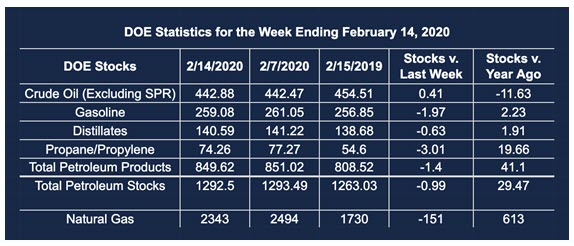
Supply/demand data in the United States for the week ending Feb. 14, 2020, were released by the Energy Information Administration.
Total commercial stocks of petroleum fell by 1.0 million barrels during the week ending Feb. 14, 2020.
Commercial crude oil supplies in the United States increased by 0.4 million barrels from the previous report week to 442.9 million barrels.
Crude oil inventory changes by PAD District:
PADD 1: Down 0.7 million barrels to 10.2 million barrels
PADD 2: Down 1.1 million barrels to 126.6 million barrels
PADD 3: Plus 1.4 million barrels to 230.7 million barrels
PADD 4: Down 0.8 million barrels to 20.8 million barrels
PADD 5: Plus 1.6 million barrels to 54.6 million barrels
Cushing, Oklahoma inventories fell 0.2 million barrels from the previous report week to 38.2 million barrels.
Domestic crude oil production was unchanged from the previous report week at 13.0 million barrels daily.
Crude oil imports averaged 6.547 million barrels per day, a daily decrease of 431,000 barrels. Exports rose 594,000 barrels daily to 3.564 million barrels per day.
Refineries used 89.4 percent of capacity, up 1.4% from the previous report week.
Crude oil inputs to refineries increased 190,000 barrels daily; there were 16.210 million barrels per day of crude oil run to facilities. Gross inputs, which include blending stocks, rose 267,000 barrels daily to reach 16.812 million barrels daily.
Total petroleum product inventories fell 1.4 million barrels from the previous report week.
Gasoline stocks decreased 2.0 million barrels daily from the previous report week; total stocks are 259.1 million barrels.
Demand for gasoline rose 196,000 barrels per day to 8.918 million barrels per day.
Total product demand decreased 1.378 million barrels daily to 19.590 million barrels per day.
Distillate fuel oil stocks decreased 0.6 million barrels from the previous report week; distillate stocks are at 140.6 million barrels. EIA reported national distillate demand at 3.728 million barrels per day during the report week, a decrease of 92,000 barrels daily.
Propane stocks decreased 3.0 million barrels from the previous report week; propane stocks are 74.3 million barrels. The report estimated current demand at 1.627 million barrels per day, a decrease of 463,000 barrels daily from the previous report week.
Natural Gas
According to EIA:
The net withdrawal [of natural gas] from storage totaled 151 Bcf for the week ending February 14, compared with the five-year (2015–19) average net withdrawal of 136 Bcf and last year’s net withdrawal of 163 Bcf during the same week. Working natural gas stocks totaled 2,343 Bcf, which is 200 Bcf more than the five-year average and 613 Bcf more than last year at this time.
The average rate of withdrawal from storage is 11% lower than the five-year average so far in the withdrawal season (November through March). If the rate of withdrawal from storage matched the five-year average of 9.7 Bcf/d for the remainder of the withdrawal season, the total inventory would be 1,897 Bcf on March 31, which is 200 Bcf higher than the five-year average of 1,697 Bcf for that time of year.
Futures trading involves significant risk and is not suitable for everyone. Transactions in securities futures, commodity and index futures and options on future markets carry a high degree of risk. The amount of initial margin is small relative to the value of the futures contract, meaning that transactions are heavily “leveraged”. A relatively small market movement will have a proportionately larger impact on the funds you have deposited or will have to deposit: this may work against you as well as for you. You may sustain a total loss of initial margin funds and any additional funds deposited with the clearing firm to maintain your position. If the market moves against your position or margin levels are increased, you may be called upon to pay substantial additional funds on short notice to maintain your position. If you fail to comply with a request for additional funds within the time prescribed, your position may be liquidated at a loss and you will be liable for any resulting deficit. Past performance may not be indicative of future results. This is not an offer to invest in any investment program.
Powerhouse is a registered affiliate of Coquest, Inc.
Was this helpful? We’d like your feedback.
Please respond to [email protected]
Copyright© 2020 Powerhouse, All rights reserved.