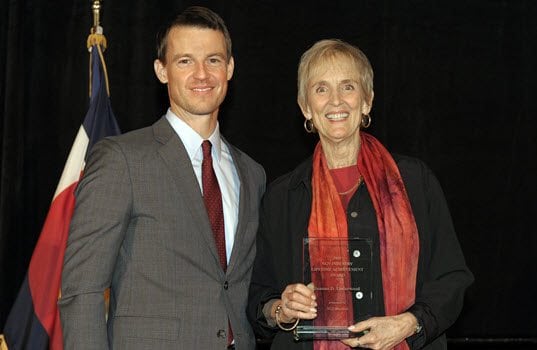

Photo: Joanna Underwood receiving the award from NGVA President Matthew Godlewski, credit: NGVA.
Joanna Underwood, president of the non-profit Energy Vision, was honored on Sept. 15 with a lifetime achievement award from NGVAmerica, a national organization promoting natural gas as a clean, domestic, safe and abundant transportation fuel. A pioneering figure in the environmental movement since the early 1970s, Underwood was an early champion of natural gas as an alternative vehicle fuel. In recent years, she has been a prominent advocate of the renewable form of natural gas (RNG) made from organic waste.
The NGV Achievement Awards recognize recipients for “outstanding leadership, vision and innovation” in advancing natural gas as a transportation fuel. Award winners are selected from nominations submitted by the NGVA membership, which consists of more than 230 companies, environmental groups, and government organizations. At the awards ceremony in Denver today, more than 500 natural gas industry leaders gathered from across the U.S. to honor this year’s winners.
“It’s very gratifying to be recognized by this distinguished group,” said Underwood. “And it’s heartening to see from this gathering how robust the natural gas vehicle field has become. It wasn’t so long ago that natural gas vehicles were a newly minted alternative concept. Today, they’re becoming mainstream, and natural gas is evolving into a renewable, scalable transportation fuel.”
Throughout her career, Joanna has worked with scientists, government and business leaders and investors to identify and promote environmental solutions and beneficial technologies for a sustainable future.
In 1974 she founded INFORM where she led seminal research documenting natural gas as the cleanest, most promising fuel alternative to petroleum-based vehicle fuel, especially for buses and refuse trucks, with greenhouse gas emissions at least 20% lower than gasoline or diesel fuels. Today, more than a third of transit buses run on natural gas, and more than half of new refuse truck orders call for natural gas engines.
In 2007 Joanna founded Energy Vision, where she has led a global effort to scale up renewable natural gas as a vehicle fuel. Made from organic waste, RNG requires no drilling and is a renewable resource. RNG is as clean burning as fossil natural gas, but has greenhouse gas emissions 90% lower than gasoline or diesel. According to the California Air Resources Board, when RNG is made from food waste in anaerobic digesters, it has net-zero or even net-negative greenhouse gas emissions over its lifecycle.
“RNG is the lowest-carbon fuel available, and it’s commercially viable and scalable today,” said Underwood. “With the eyes of the world turning to the Paris climate talks, the energy sector is urgently seeking future solutions that don’t just slow the buildup of greenhouse gases in the atmosphere, but actually help reverse it. RNG can be a big part of that, and it’s not on the distant horizon. It’s available and cost-effective now.”
Under Joanna’s leadership, Energy Vision organized the first national RNG seminar with the US Department of Energy. She co-authored the first RNG planning guide for communities, marshaling the evidence for why the highest and best use of this fuel is displacing high-cost, high-emissions diesel in heavy-duty fleets. Energy Vision continues to run workshops collaborating with utilities, businesses and government, educating Americans and inspiring new RNG initiatives.
Today, RNG powers trucks and buses in at least nine states, and projects producing RNG in landfills and anaerobic digesters are expanding. Organic waste streams are huge and ubiquitous, and could produce enough fuel to displace about 45% of on-road diesel in the US. With effective policy, RNG could displace much more than that, Underwood says.
She is also working to bring RNG to developing countries, and this year travelled to Tunisia at the request of the US Environmental Protection Agency to introduce the RNG strategy and to show how it could help reduce Tunisia’s waste, curb its emissions, and build its economy.