
Some auto manufacturers have a vision of the future vehicle market in which fuel cell electric vehicles do not replace battery electric vehicles, but instead complement them within a spectrum of vehicle sizes and functions. Pure battery electric vehicles are seen as filling personal transportation needs in which driving distances are relatively short for the user, such as in urban settings. Hybrid electric vehicles are seen in the mid-term as perhaps being the dominant passenger vehicle propulsion system. And for greater driving distances and larger vehicle sizes, FCEVs are seen as a potential long-term application for passenger vehicles, transit buses and heavy duty long-haul trucks.
So Where Do We Fuel These Things?

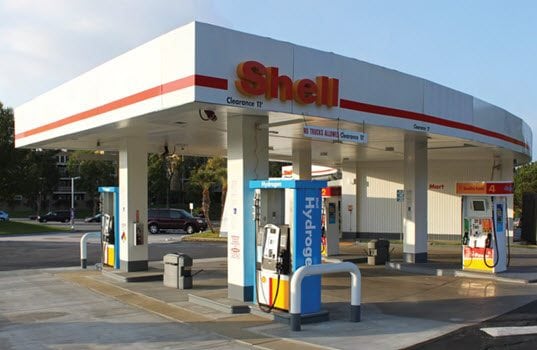
Shell Hydrogen Station in Newport Beach
You can lease a hydrogen FCEV today – if you live near a hydrogen fueling station in California. For those people interested in leasing, you can visit the Mercedes Benz, Honda and Hyundai websites where you can apply.
With the vehicles themselves now ready for prime time, the main challenge to ensure the successful commercial market introduction of FCEVs is the expansion of hydrogen fueling infrastructure. Currently the state of California has nine public hydrogen stations (out of a total of approximately 9,000 retail fueling locations statewide) located primarily in Southern California. In addition, a total of 19 stations are currently under development in both Northern and Southern California, with two new stations in the Los Angeles area to come online by the end of June.
Guiding the network development of hydrogen fueling infrastructure in California is the California Fuel Cell Partnership (CaFCP) report “A California Road Map: Bringing Hydrogen Fuel Cell Vehicles to the Golden State.” Published in 2012, the Roadmap represents the collective thinking and expertise of all the CaFCP members, including automakers, federal and state government agencies and station providers, and uses the modeling expertise of its university partners at UC Irvine and UC Davis as well as the DOE National Renewable Energy Lab (NREL).
The Roadmap is about hydrogen fueling infrastructure coverage in the state as well as capacity (i.e. commercial needs). The hydrogen fueling infrastructure model differs from that of other alternative fuels. Unlike CNG, which was introduced in fleet environments with the expectation of then expanding to the consumer market, hydrogen fueling stations are being introduced initially into the mass consumer retail market. This intentional focus on the passenger vehicle market requires that consumers have refueling experiences as close to possible as they do currently for their gasoline powered vehicles. Therefore, this requires an initial introduction of hydrogen fueling infrastructure located at existing retail fueling outlets that passenger vehicle owners currently use on a daily basis. In short, auto manufacturers want the consumer experience with hydrogen fuel cell vehicles to be as close as possible to that of their current passenger vehicle.
The Roadmap analysis identified that a minimum number of 68 strategically placed hydrogen fueling stations located within five primary geographic clusters in the state of California would be needed for the auto manufacturers to begin introducing FCEVs in the thousands to the commercial market. These five clusters are:
- Santa Monica and West LA
- Torrance and Nearby Coastal Cities
- Coastal and Southern Orange County
- South San Francisco Bay Area
- Berkeley
In addition to these five cluster locations, the Roadmap analysis identified a number of connector locations (such as the Central Valley) and destination locations (such as San Diego, Santa Barbara and Palm Springs) which would also require hydrogen fueling infrastructure to ensure the coverage necessary for consumers feel confident that they can travel from home to work and to popular vacation destination areas in the state.
With the signing into law of AB 8 in September of 2013 by Governor Jerry Brown, the State of California has committed to provide up to $20 million per year for the next 10 years for the construction of hydrogen fueling stations throughout the state. This funding commitment by the State of California will help ensure that a network of approximately 100 fueling stations throughout the state will provide the foundation for the successful commercial introduction of FCEVs to the car buying public.
Station Equipment and Sources of Hydrogen
While there is a common set of station equipment associated with hydrogen fueling stations, such as the compressor, storage tanks, chiller and dispenser, there are multiple methods of producing and storing hydrogen for retail fueling facilities. These include gaseous compressed storage, liquid storage, electrolysis, steam methane reformation of natural gas, and use of existing hydrogen pipelines.