
By Chris Traczek
Owners and operators of retail-fueling sites face a laundry list of daily challenges, from dealing with constantly fluctuating fuel prices to ensuring that the safety and integrity of the fueling process is reliably maintained. One of the most basic concerns is knowing that the correct fuel is being delivered into the correct underground storage tank (UST) during fuel deliveries.
Unfortunately, there have been many instances where the wrong fuel has been put in the wrong UST—an occurrence known as a “cross-drop” that cross-contaminates the existing fuel in the UST. Whether that fuel cost $2 or $4 a gallon, it can lead to thousands of dollars being needlessly spent to rectify the error.
“Cross-contamination is an unfortunate part of the industry,” said John Hamel, President of J&S Transport Co., Inc., Lynn, Mass. “We all want to think it doesn’t happen, but unfortunately, there are times that it does.”
J&S Transport is an exclusive hauler of refined petroleum products with a customer base that covers all of the major shippers in the Boston market and a network of branded and unbranded gasoline stations. The company also provides inventory management for a number of its delivery locations where it actually monitors inventory levels, schedules deliveries and observes market conditions before scheduling a delivery.

John Hamel, President of J&S Transport Co., Inc.
Hamel and his drivers are well aware of the costs that are incurred from the simple cross-contamination of fuel, but there are a number of ancillary costs that also must be accounted for when the wrong fuel finds its way into the wrong UST. These include:
- Cost to pump out the contaminated tank
- Use of a trailer to pump the bad fuel into
- Cost to replace the bad fuel
- Loss of fuel-purchase revenue during station downtime
- Cost to dispose of the ruined fuel, which can be the difficult to “find a home for” at times
There are strict protocols that need to be followed when disposing of ruined fuel, which is why the U.S. Environmental Protection Agency (EPA) in 2002 helped create the Environmental Compliance for Automotive Recyclers (ECAR) website (www.ecarcenter.org). The ECAR is a compliance-assistance center for the automotive-recycling industry and includes state-by-state regulations that govern the handling and disposal of ruined motor fuels.
Another industry veteran who has seen the damage that cross-drops can do to a fleet-fueling operation’s equipment, bottom line and reputation is Rick Ross, Managing Partner for Leawood, KS-based Star Transport. Star Transport operates a fleet of 80 trailers and 70 pieces of power equipment, all dedicated to making retail-fuel deliveries to a customer base that spans a region from Houston, TX, to St. Louis, MO, and Colorado to Arkansas, and includes such well-known brands as QuikTrip, Kroeger’s and Circle K. To adequately serve its wide customer network, Star Transport operates terminal facilities in Oklahoma City, OK; Springfield, MO; Kansas City, MO; Houston; and Denver, CO.
“Trying to eliminate cross-drops when you look at gas on diesel or diesel on gas is an industry problem system-wide,” admitted Ross. “Years ago, the cost of taking care of a cross-drop was not significant; today, it is significant.”
Tackling The Problem
Realizing that cross-drops can cost fleets tens to hundreds of thousands of dollars a year in lost fuel and remediation fees was the easy part. The much tougher challenge was devising a solution. It was a task that intrigued Civacon, Kansas City, MO, a member of the OPW transportation business unit and a global leader in the design, engineering and manufacturing of bottom-loading, vapor-recovery and overfill-detection systems for use in the petroleum-products-delivery industry.
“For years, we had been hearing from our customers just how damaging cross-drops could be to their businesses, from not only a lost-fuel perspective, but also from the loss of reputation that could result and harm to future business prospects,” said Randy Robinson, National Sales Manager for Civacon, part of OPW. “Our charge, then, was to develop a system that not only eliminated costly cross-drops, but also did it in a way that would not adversely affect delivery times or be too complicated for the driver to implement.”
To help move the development process along, Civacon solicited input on the industry’s needs from companies that were on the front lines in the battle against cross-drops.
“Civacon came to us and asked what were some of the things we’d like to change or do or improve on, so when they asked us what we needed, we were quite excited to hear that they had chosen to take on this cross-drop technology problem,” said Ross.
“We were fortunate to be approached by Civacon with a new initiative and the new product line they were developing,” added Hamel. “We were asked if we would test this new product. The experience so far has been very positive, great response from our drivers and the shipping community we haul for are appreciative of the fact that we are forward-thinking and looking out for the liability with their customers.”
Call For COPS
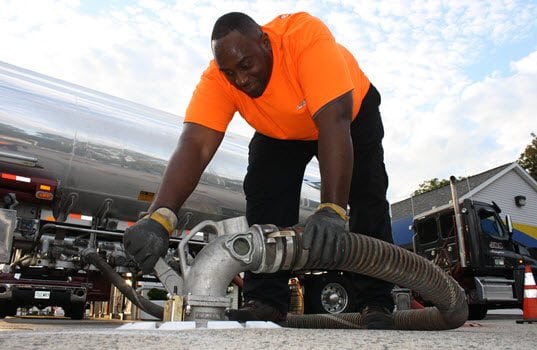
The collaboration between Civacon and its customers ultimately resulted in the creation of the Cross-Over Prevention System, or COPS, which was introduced to the fuel-hauling industry at the National Tank Truck Carriers’ Show in Houston in October 2014. COPS has been designed to remove human error from the retail-site delivery process with no modifications required at the rack and minimal additions to the site’s USTs. The heart of the system is a Smart Elbow that communicates via RFID tag with the controller on the fuel trailer. If the information from the RFID tag does not match the fuel with the UST, a delivery cannot be initiated (See Sidebar).
 “It just allows you to think before you drop,” said Steve Medley, a driver for Star Transport. “It doesn’t let you make a mistake. It makes you slow down and think about things before you just go at it.”
“I’ve been with Star for 10 years and I’ve seen cross-contamination cost the company a lot of money,” added driver Kevin Youngstrom. “It’s also cost me a little bit of money and time because you have to get it back out of the ground, there’s damage to vehicles. There’s a lot involved if you make a mistake. As a driver, having the Civacon system on my truck makes me feel more confident that I’ll be able to do my job correctly, which benefits me and my company.”
In addition to preventing cross-drops, the system also has locking API adaptors that protect the trailer from product theft, which is another ancillary cost that fuel transporters are attempting to eliminate.
Conclusion
Fuel-transport companies and their customers have enough to worry about without wondering if the right fuel is going into the right tank during a delivery. While human error is generally the cause of cross-drops, that aspect is removed from the delivery equation with the implementation of Civacon’s COPS, which uses tried-and-true RFID wireless communication technology to ensure that the correct delivery is made each and every time.
“We’ve always been a very safe carrier, always been able to attract good people, always had high-quality equipment and adding the COPS system to our trailers, or ordering new trailers with the COPS system on them, is just one more step that makes us stronger, makes us better than anybody else in the industry,” said Ross. “We see nothing but upside with this system.”
Chris Traczek is a freelance writer who was a former Editor-In-Chief for National Petroleum News and Fuel Oil News magazines. He has been reporting on the retail-petroleum industry for 15+ years. He can be reached at [email protected].
COPS
First and foremost, Civacon developed its Cross-Over Prevention System (COPS) as a way to prevent costly cross-drops of fuel during retail fuel deliveries. The added benefit of COPS, however, is that it also increases the efficiency and cost-effectiveness of the delivery process, resulting in a streamlined operation and healthier bottom line.
All that’s required are three simple steps to complete a fuel delivery with a tank trailer and retail site that have been outfitted with COPS:
• Connect: The API coupler on the trailer is connected to the Smart Elbow by a delivery hose. The Smart Elbow connects to the UST’s adaptor when an RFID tag is permanently installed. COPS also ensures that the Smart Elbow is securely attached to the UST adaptor, which cuts down on the chance for spills.
• Communicate: The Smart Elbow transmits the RFID tag’s fuel grade to the main controller. The fuel will only be allowed to flow when there is a match with the RFID tag.
• Prevention: Cross-contamination is automatically prevented by COPS when a driver tries to open a non-matching product compartment.
“From a driver’s perspective, the system works well,” said Bob Bryson, a driver for J&S Transport Co., Inc., Lynn, MA. “It does give you peace of mind that you’re not going to cross-drop and it doesn’t add any more time. I wish more stations actually had that. I mean it’s great, it’s a great system.”