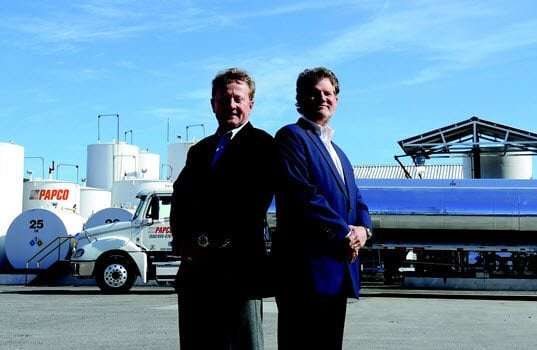

In addition to fuel wholesalers, PAPCO serves commercial end users and government accounts. The latter range from federal and state agencies to local school districts and mass transit authorities. These customers likewise look to PAPCO for customized supply and price risk management programs. “We use the term ‘structured deal’ to describe what we do,” relates Gilmore. “We do more than say, ‘Here’s our price, so come and get it.’ What differentiates us from competitors is that we can do everything—from pricing options to onsite fuel delivery – that meets the different needs and risk tolerance of each customer.”
For example, PAPCO can design an automated inventory management program to replace manual ordering and thus improve efficiency and reduce labor costs. “We’ve got the latest technology to monitor inventory levels so that delivery schedules are optimized and product outages are prevented,” explains Rosenfeldt. “And if a customer is worried about the cost of carrying inventory, we offer consigned fuel programs so they’re only billed for fuel as they use it.”
Another fuel management tool is the PAPCO Universal Fleet Card powered by the Voyager Network. Accepted at more than 230,000 locations nationwide, the card allows fleet owners to organize fuel costs and reporting, capture and store electronic receipts, control driver accounts and individual card usage, and set restrictions by driver or vehicle. These data are then accessible through an online reporting system that also monitors transactions in real time.
Perhaps the greatest value-added proposition that PAPCO brings to the table, however, is its price risk management services. “We explain our program to customers in six simple steps,” says Rosenfeldt.
“First, we train the customer’s key staff in the basics of price risk management and provide them complete access to our resources. Second, we work with the customer to create benchmarks such as budget objectives, risk tolerances, timing, and price points. Third, we analyze the market and guide the customer through their options. Fourth, we develop and execute a risk management strategy tailored to the customer’s needs, goals, and risk profile. Then the last two steps are continuous monitoring and evaluation of results.”
While most customers are familiar with fixed-price agreements, PAPCO’s suite of risk management tools include market index pricing, NYMEX triggers, index discounts with price floors, price caps, and Department of Energy indexing. “
If you don’t do anything to manage market volatility, you’re allowing an unpredictable and unstable market to set your fuel budget,” explains Rosenfeldt, “and one of the most effective tools to manage volatility is hedging, which is basically a way to transfer risk. Using carefully selected hedging products isn’t speculating on the market or gambling on the price of fuel. It’s a way to offset, or hedge against, inevitable fluctuations in the energy markets.”
Let’s Make a Dealer
On the retail side, PAPCO has exited its former company-operated sites and instead has developed a retail strategy that is focused on serving a growing network of 170 dealers in five states. “We look, most of all, at the character and quality of potential dealers,” says Malbon. “Then we can help them get off the ground, open up for business, and provide ongoing site support as well as fuel supply. If their business grows, so does ours.”
In the initial stages, PAPCO can aid dealers in evaluating a site, choosing a fuel brand, selecting vendors, procuring equipment bids, and evaluating financing options. To get a new, remodeled, or rebuilt site up and running—and then to monitor ongoing performance—PAPCO can help set up and maintain systems to manage equipment, inventory, and imaging.
Dealers can opt for a branded retail fuel program through PAPCO’s longtime relationships with BP, Citgo, ExxonMobil, Shell, and Valero. “We not only supply the fuel,” states Malbon. “We’re unique in that we provide our branded dealers with the services of onsite marketing specialists. They can advise these dealers on everything from co-op advertising to point-of-purchase systems and even employee uniforms.” Yet PAPCO dealers can also opt for a customized unbranded retail fuel program. “To succeed as an unbranded marketer, you need to present a razor-sharp alternative to the majors and their national brand identities,” observes Malbon. “We can help by tailoring a program—unique to each dealer—that combines ratable supply, competitive pricing, a clean image, and a flexible credit card program.”
Both branded and unbranded PAPCO dealers are provided online account management, merchandising and promotional support, fuel inventory monitoring and management, industry news and updates, and a paid membership in the National Association of Convenience Stores.
In addition to fuel marketing, PAPCO’s big picture is rounded out by its lubricants and home heating divisions. The company provides Mobil lubricants to commercial, automotive, and industrial customers across southeastern and central Virginia and northeastern North Carolina. Meanwhile, Malbon admits, “Home heating is a declining business, given the inroads made by natural gas. However, it is one of our legacy businesses, and we will continue to service customers that still rely on oil for their homes.”
What Lies Ahead
PAPCO’s expansion has brought both rewards and challenges. “We identify ourselves as a petroleum marketing company that’s involved in many channels. That affords us a certain comfort zone because it evens out the peaks and valleys in our company overall. When one business unit is down, another one is always bound to be up.”
Yet as Malbon concedes, “The tradeoff is that the complexity of our business has really increased. Now that we’ve expanded into so many new markets, we have to deal with the fact that every jurisdiction has different taxes and different gasoline formulations. How do we store and ship the correct product at the correct time? It’s a question that affects us every day. And of course, the petroleum industry itself is always changing.”
To stay on top of developments and learn from others, PAPCO has been a member of SIGMA since the late 1990s. “You get out of a professional membership what you put into it,” believes Gilmore. “But as we’ve participated in SIGMA over the years, we’ve gotten back even more than what we’ve put in. The information, the networking, the share groups—we’ve used all the programs that SIGMA offers. Though SIGMA members might sometimes compete, we’ve been so glad that our fellow marketers are always so willing to share their ideas.”
Looking to the future, PAPCO is emerging from a substantial expansion cycle and taking stock of what comes next. “We started expanding more than a decade ago because we’d saturated our home market,” recounts Malbon. “But now we market all along the Colonial Pipeline and only have limited shares of our newer markets. So there’s still a lot of room for growth in just the 15 states where we’ve expanded. Then, too, fuel demand isn’t as robust as it once was—and the 2016 CAFE [Corporate Average Fuel Economy] standards are likely to continue that trend.”
Another aspect of PAPCO’s recent history is a decision some years ago to take the company out of family ownership. Today, Malbon and Gilmore are the owners and both have committed themselves to leading the business well into the 2020s. “We both enjoy the business and the industry,” says Gilmore, “and are excited about them both.” Yet the two men admit the inevitable will come someday and that the time to start thinking about it is well in advance.
“We want to build the value of the company, but not just to maximize any sale price,” states Malbon, “which is why we believe in ‘polishing the apple’ every day.” “We are approached regularly with opportunities to improve our business, and we evaluate any potential business combinations as they present themselves,” continues Malbon. “As always, any opportunity we consider must align well with our culture, values and customer value proposition, while creating value and opportunities for customers, employees and shareholders alike.”