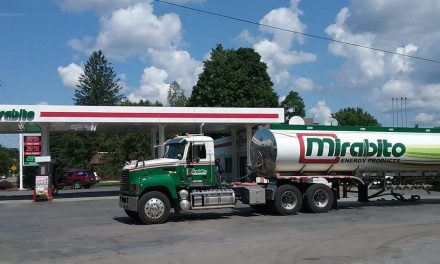


A simple look at an often-mysterious industry reality.
By Brian Reynolds
There are many departments within any petroleum organization that require a great deal of specialization and experience. A quick list includes daily supply chain operations, procurement, construction, environmental compliance, IT/security/payment systems, pricing, marketing and accounting. All these fields require a great deal of education and experience.
One concept should be easy to understand, but frequently isn’t—the concept of net and gross gallons.
If Rod Serling from “The Twilight Zone” were in the petroleum industry, I could imagine him saying: “There is a fifth dimension beyond what is known to man. It is in the middle between science and superstition. This is an area we call net and gross gallons.”
Now, as Serling would say, “Let’s unlock this door.” The paint industry originally developed the concept of shipping net and gross gallons in the late 1800s. It appeared that the paint level changed during shipping due to a visible paint line in the barrel. This phenomenon led to the delivery and billing process of the net and gross temperature-adjusted to a mathematically stable 60 degrees that then became the basis for invoicing.
Fuel product transactions in the downstream petroleum market often refer to both net and gross gallons. Depending on various considerations, marketers pay for fuel on net or on gross. Many marketers track unit (gallon) inventory based entirely on which method they use to pay for it. For example, if they pay their suppliers for net gallons, they update their inventory systems with net gallons.
This practice will produce a correct accounting gross profit calculation for the financial statement. But it does not produce the truest over/short gallon result.
It’s useful to start with this: All statistical inventory reconciliation (SIR) providers require gross gallons. Their SIR certification demands it. Those who have studied the issues of fuel inventory tracking most thoroughly are in complete agreement that gross gallon inventory accounting produces a more reliable metric than a method that books receipts using net gallons.
Consider this: The meters at the measure gross gallons. The meters at the retail site measure gross gallons through the dispensers. The ATG measures gross gallons.
Before any dialogue for net and gross gallons is discussed, lets define the meaning of net and gross. Gross means the total or whole amount of something, whereas net is what remains after the whole after certain deductions are made. In the case of petroleum, the deductions for this conversation are temperature. In finances we talk about gross profit margins, but what matters the most is net profits. Everybody reading this article probably knows this. So why is net and gross gallons seemingly difficult to understand? Mostly because the answer keeps changing.
The reason why the answer changes is the reason why the standardization was created in the first place. The only time petroleum gallons are stable is when the temperature of the product, the outside temperature and the temperature inside the tank all equals 60 degrees. Or more simply stated, net gallons equals gross gallons at 60 degrees Fahrenheit. Which hardly ever happens—hence the concept of temperature adjusted. No matter what the temperature is, the price was mathematically adjusted as if though it was 60 degrees.
So if fuel is warmer than 60 degrees it is going to shrink slightly. If it is colder than 60 degrees it is going to expand slightly. The good news is that the reality of how much it expands or contracts is not a large number either way.
There is also another reality that deserves consideration. Temperature is not the exclusive reason for a loss. It can be lost due to meter drift at the terminal or dispenser, theft, delivery issues and of course leaks. All of these possible sources of loss can be detected and then further minimized through actionable processes.
As it applies to fuel inventory reconciliation, another quote from Rod Serling is: “It may be said with a degree of assurance that not everything that meets the eye is as it appears.” Just because the truck delivered the fuel, ATG acknowledged a delivery and an invoice shows up in the mail, that doesn’t mean that you shouldn’t question the accuracy of the information.
 Brian Reynolds began his career working as a teenager in his family-owned jobbership in Cisco, Texas, and was at the forefront of many significant industry milestones, including cardlock systems in the 1980s and high-volume supermarket fueling centers in the 1990s. He was one of the key architects of inventing reward-based fueling loyalty in the 2000s. He currently works as an industry consultant.