
The U.S. Energy Information Administration (EIA) released its weekly data on diesel and gasoline retail prices for the week ended July 15, 2019. Gasoline prices rose for the third week in a row. Diesel prices eased slightly. On a national average basis, retail prices for gasoline rose by 3.6 cents/gallon for the week. Gasoline prices rose most significantly in the Midwest, Gulf Coast, and East Coast. Supplies in these PADDs have been affected by the closure of the Philadelphia Energy Solutions (PES) refinery, and they also were influenced by Tropical Storm Barry, which made landfall in Louisiana as a Category 1 hurricane on Saturday, July 13. Barry caused prices to rise as companies shut in oil production, refining and distribution facilities and evacuated staff. Barry quickly was downgraded to a tropical storm, then to a tropical depression as it moved north, bringing torrential rains. National average prices for gasoline were 8.6 cents/gallon below where they were in the same week one year ago. On a national average basis, retail prices for diesel declined by 0.4 cents/gallon. National average prices for diesel were 18.8 cents/gallon lower than they were in the same week last year.
Futures Prices and Retail Price Outlook
During the week July 8th-July 12, 2019, West Texas Intermediate (WTI) crude futures rose by $2.69/b (4.7%.) Gasoline futures prices rose by 5.78 cents/gallon (3.0%.) Diesel futures prices rose by 7.5 cents/gallon (3.9%.) Prices have been strengthened by the loss of the PES refinery and by disruptions caused by Tropical Storm Barry. Barry caused little damage, and prices have begun to equilibrate. Although the relationship between futures market prices and retail prices is not immediate and one-for-one, the most recent trend in futures prices suggests that gasoline and diesel prices will rise in the coming week.
Retail Diesel Prices
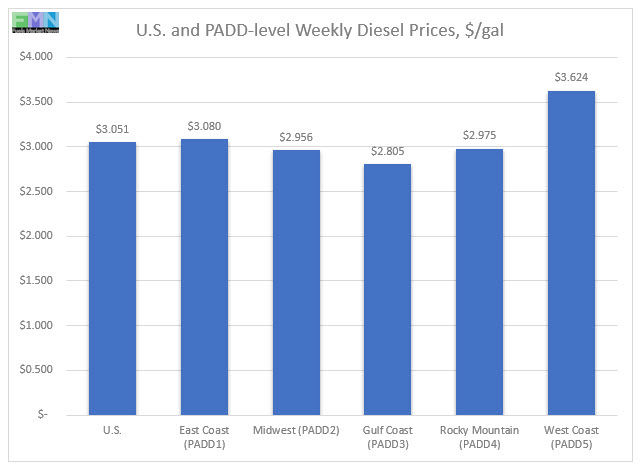
For the current week ended July 15, retail diesel prices eased by 0.4 cents to settle at an average price of $3.051/gallon. Between mid-October and late-January, retail diesel prices fell for fourteen consecutive weeks. During those fourteen weeks, the price decline totaled 42.9 cents/gallon. From February through April, diesel prices crept back up by 20.4 cents/gallon. The month of May brought a modest reversal in the upward trend in diesel prices. During the five weeks of June including the week ended July 1st, diesel prices fell more substantially, declining by 10.9 cents/gallon since the last week of May. For the current week ended July 15th, diesel prices rose slightly in the Gulf Coast PADD 3, remained flat in the Weast Coast PADD 5, and declined in PADDs 1, 2, and 4. The national average price for the week was 18.8 cents/gallon below where it was during the same week last year.
In the East Coast PADD 1, diesel prices eased slightly by 0.1 cent to arrive at an average price of $3.080/gallon. Within PADD 1, New England prices declined by 0.3 cents to average $3.131/gallon. Central Atlantic diesel prices also fell by 0.3 cents to average $3.272/gallon. Lower Atlantic prices edged up slightly by 0.1 cent to arrive at an average price of $2.941/gallon. PADD 1 prices were 15.6 cents/gallon below their prices for the same week last year.
In the Midwest PADD 2 market, retail diesel prices fell by 1.2 cents to average $2.956/gallon. This was the only significant price drop among the PADDs. Prices were 21.5 cents/gallon below their level for the same week last year. PADD 2 joined PADD 3 during the week ended June 17th in having diesel prices fall below $3/gallon.
In the Gulf Coast PADD 3, retail diesel prices edged up by 0.1 cent to average $2.805/gallon. PADD 3 typically has the lowest diesel prices among the PADDs. Prices were 19.9 cents lower than for the same week in the previous year.
In the Rocky Mountains PADD 4 market, retail diesel prices declined by 0.5 cents to settle at an average of $2.975/gallon. Two weeks ago, PADD 4 joined PADDs 3 and 2 in having diesel prices below $3/gallon. PADD 4 prices were 39.5 cents lower than for the same week in the prior year.
In the West Coast PADD 5 market, retail diesel prices remained unchanged at an average of $3.624/gallon. PADD 5 prices were 11.7 cents below their level from last year. Prices excluding California rose by 0.1 cents to arrive at an average of $3.209/gallon. This price was 24.7 cents below the retail price for the same week last year. California diesel prices eased by 0.1 cent to arrive at an average price of $3.952/gallon. Until the week ended June 24, California had been the only major market where diesel prices were above $4/gallon, and prices remained above the $4/gallon mark for nine weeks. California diesel prices were 1.6 cents lower than they were at the same week last year.


Retail Gasoline Prices
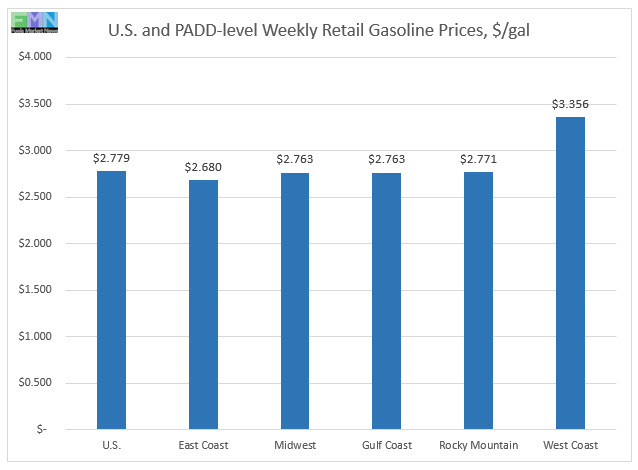
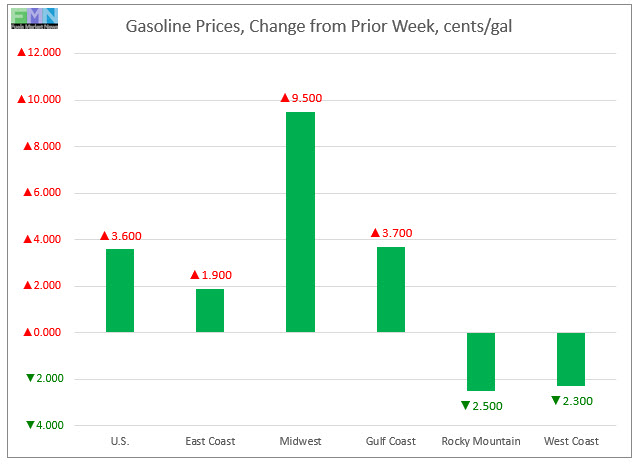
U.S. retail gasoline prices rose for the third week in a row, rising by 3.6 cents/gallon to reach an average of $2.779/gallon during the week ended July 15. Prices rose in PADDs 1, 2 and 3, and they continued to fall in PADDs 4 and 5. Retail prices for the current week were 8.6 cents per gallon lower than they were one year ago. Gasoline prices hit a peak of $2.903/gallon during the week ended October 8, 2018. Prices then slid downward for fourteen weeks in a row, shedding a total of 66.6 cents per gallon. In the next seventeen weeks, prices marched back up by 66.0 cents/gallon. Prices came very close to the peak they hit in early October, before the months of May and the June brought an easing of prices. Gasoline prices in May and June retreated by 23.3 cents per gallon. The week ended July 1st reversed that downward trend and sent prices up once again.
The increase in retail gasoline prices outpaced the increases in crude oil prices and diesel prices mainly because of the explosion and fire at the 335,000-bpd, gasoline-maximizing Philadelphia Energy Systems (PES) refinery. The owners, already under financial pressure, announced that they would not re-open the refinery, and the government demurred to use public funds to finance repairs. Gasoline prices rose in PADD 1 and in neighboring PADDs 2 and 3, which are sources of fuel supply to the East Coast. Tropical Storm Barry also caused an uptick in prices as it disrupted oil production, refining and distribution.
For the current week ended July 15th, East Coast PADD 1 retail prices for gasoline rose by 1.9 cents to average $2.680/gallon. The average price was 12.1 cents/gallon below where it was during the same week last year. Within PADD 1, New England prices rose by 3.3 cents to average $2.728/gallon. Central Atlantic market prices rose by 2.0 cents to average $2.820/gallon. Prices in the Lower Atlantic market rose by 1.5 cents to reach an average of $2.580/gallon.
In the Midwest PADD 2 market, retail gasoline prices jumped by 9.5 cents to arrive at an average price of $2.763/gallon. This was the largest price increase among the PADDs. PADD 2 prices for the current week were 3.3 cents/gallon lower than they were for the same week last year.
In the Gulf Coast PADD 3 market, gasoline prices increased by 3.7 cents to average $2.455/gallon. PADD 3 continues to have the lowest average prices among the PADDs. Prices for the week were 14.7 cents lower than for the same week last year.
In the Rocky Mountains PADD 4 market, gasoline pump prices fell by 2.5 cents to settle at an average price of $2.771/gallon. This week’s prices were 18.4 cents lower than at the same time last year.
In the West Coast PADD 5 market, retail gasoline prices fell by 2.3 cents to arrive at an average of $3.356/gallon. PADD 5 continues to have the highest gasoline prices among the five PADDs. It is the only PADD where retail prices are above $3/gallon. Prices were 2.2 cents below last year’s level. Excluding California, West Coast prices fell by 2.4 cents to average $3.055/gallon. This price was 13.0 cents lower than at the same time last year. In California, pump prices fell by 2.2 cents to average $3.605/gallon. California prices were 7.0 cents per gallon above their levels from the same week last year.