
His path through the industry has taught him the value in maximizing customer experience.
By Keith Reid
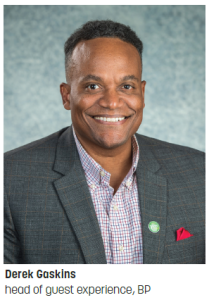 Derek Gaskins began his career in convenience retailing in 2002 when he left his position as a brand manager at Procter & Gamble (P&G) to lead the non-food operations for Giant Eagle. While there, he helped launch the GetGo convenience brand following the acquisition of Crossroads stations from Guttman Oil. Gaskins also led the marketing team during the development of Giant Eagle Express and Market District Express, as well as the company’s fuelperks loyalty program.
In 2009, he joined NACS as vice president of marketing, where he oversaw brand development and integration, social network campaign execution and channel analytics.
His retail customer-facing skillset was reapplied in 2011 when he joined Mid-Atlantic Convenience Stores (MACS) as SVP of merchandising and marketing. He has also served as Rutter’s chief customer officer and as Yesway’s chief marketing officer.
Gaskins currently works as BP’s head of guest experience, setting the go-to-market strategy and supporting how BP engages with consumers across its U.S. retail stores. FMN talked to Gaskins about what he thinks is important in convenience retailing today.
What prompted your move into the convenience industry?
When I was at P&G—20-plus years ago—I saw where the consumer trends were going. I felt small-format retailing would be a winner. And today it is stronger than ever. A lot of things accelerated that—the Great Recession and more recently Covid. We were one of the only places open when the world shut down. And our industry rose to the challenge.
Not only are we fueling the communities that we serve, but we fuel first responders, we fuel the heroes and the police and fire departments when there’s a natural disaster, a hurricane, a fire—any of those things. We are where the consumers, and the people who are serving those communities, go when they need supplies. They rely on us for fuel, hydration, replenishment and nourishment.
How would you categorize fuel in the convenience store mix of offers?
I look at fuel as indispensable. It’s a traffic driver—a necessity that vehicles need. Yes, there are shifting landscapes, more efficient vehicles and EVs—the long-term demand will go down, but it will remain vital. And fueling the world is something that as a channel and industry we are uniquely serviced and set to do.
And that ties into the rest of the store offers. The number one benefit that consumers want as an incentive or as a reward is discounts and savings on fuel. When I was at Giant Eagle we launched fuelperks and it was very straightforward because that was the consumer benefit. Fuel remains the dominant perceived value for such programs throughout the industry from consumers who engage with convenience retail.
Describe your NACS experience.
I joined the association as the VP of marketing and worked with Henry Armour to reposition NACS more globally and to move from a gasoline focus to more broadly encompass the range of fuels and charging. It gave me more purpose in areas in which I have always had a passion for in retail.
I think what NACS uniquely did was help me look across channels. P&G was a global brand and I had an opportunity to launch products and do global research, but NACS was looking at it through the lens of a retailer and across the 28 categories that comprise inside sales.
From my P&G experience as a CPG brand manager, I realized that the convenience channel oftentimes doesn’t get equity. Simply put, we’re subsidizing other channels. You see mass marketers or the club channel, and their cost of goods oftentimes is significantly lower, so much so that my retail prices may appear to be insulting—but the consumer doesn’t understand why. Consumers see something like Pringles and ask “How come it’s more expensive in a convenience store compared to my grocery store?” So, when I engage with suppliers, it’s around more equity as a channel.
I also received some insights at NACS though its expanded global push on how to look outside your market, and even your country, for things that work.
Henry Armour likes to say—I think he credited William Gibson—that “the future’s already here, it’s just unevenly distributed.” That means that you can look globally at other markets and obtain things that work and best practices and apply them in your market.
I saw that firsthand when I was at Rutter’s and we hosted some Australian retailers. They were fascinated with pay at the pump, and I was thinking this is something we did decades ago. They were asking if you lost foot traffic inside the stores. As we’ve learned, if you make it easy for the customer to do business, you’ll do more business. Yet they did not learn this insight until they saw it in practice in another country.
I’m fortunate now that at BP I can do that without looking outside of the company. With our global operations, I can see at what’s happening in the U.K. or New Zealand or Australia and other regions where we operate, and our operations abroad can see what we are doing in the United States.
You have spoken before about working with industry legend the late Joe Petrowski while at Yesway. Joe had a long history in the industry including his time as CEO of the Cumberland Gulf Group. Could you speak about that experience?
I looked up to him. He was a role model, a mentor. Our backgrounds are similar in that we both came from some tough places, Joe from Brockton, Massachusetts, and me from inner city Washington, D.C.
Joe had an MBA from Harvard and was one of the sharpest guys in the room. His sense of humor, his wit, his relationship building—they were outstanding. He was just a giant of a man in every way. Joe took a liking to me, he made time for me and we kept in touch for the rest of his career. I didn’t realize at the end how much he was fighting for his life, but he was still invested in the industry and his company and the business.
Whenever I’m mentoring a young marketer, category or brand manager, I’m always saying understand those who came before you and respect and learn from them. This industry was built by some giants. You know, when you look at Lonnie Allsup and what he did with Allsup’s, or you look at Stan Sheetz and what that has turned into, or Dick Wood and Wawa, or James Thornton and what he has done with that brand—I think we have a burden to carry it forward.
What do retailers tend to overlook in the consumer relationship?
Know the customer and be obsessed with them. At BP we have a concept: guest obsession. Observing consumers is critical. One of my franchisees was telling me how he goes in stores and literally just observes consumers. And I love that.
A lot of us convenience retailers will look at research, syndicated data, sales, and we’ll get Nielsen and Circana and the analysis and say this is what it is. That’s great, but go into a store, slow down and observe. Watch the behavior—how they shop, the adjacencies, the hot zones. That helps you understand the needs that consumers often cannot articulate. You can be a very scientific marketer, which is great and I consider myself to be one, but recognize the art of retailing.
Can you describe BP’s retail and marketing today?
We are committed to growth, and we are truly global. I’ve worked for some great brands, great companies, but the people that you encounter here are world class at what they do and are committed to it.
Another thing that stands out is our franchises. We have multiple banners, and we look to leverage the scale and BP’s core growth across all of them. You have ampm, which is a very successful regional brand on the West Coast that we’re looking to grow east of the Rockies.
TA, one of the big three travel center brands nationwide, is committed to first responders, the military and supporting the communities, which is great. That professional driver segment is a hero. They transport the goods that keep this country and this world going, and TA is at the heart of all that.
And then you have Thorntons. Thorntons has almost been a training ground for talent when you look industry wide with folk who have moved on to lead some of the best retail brands out here. BP has preserved that legacy and has grown that banner and the brand.
And summing it up with BP and Amoco, we are growing our branded retailers and wholesalers. We have a brand that is resurgent and are committed to the direction that our CEO set to expand our culture of excellence.
 Keith Reid is editor-in-chief of Fuels Market News. He can be reached at [email protected].