
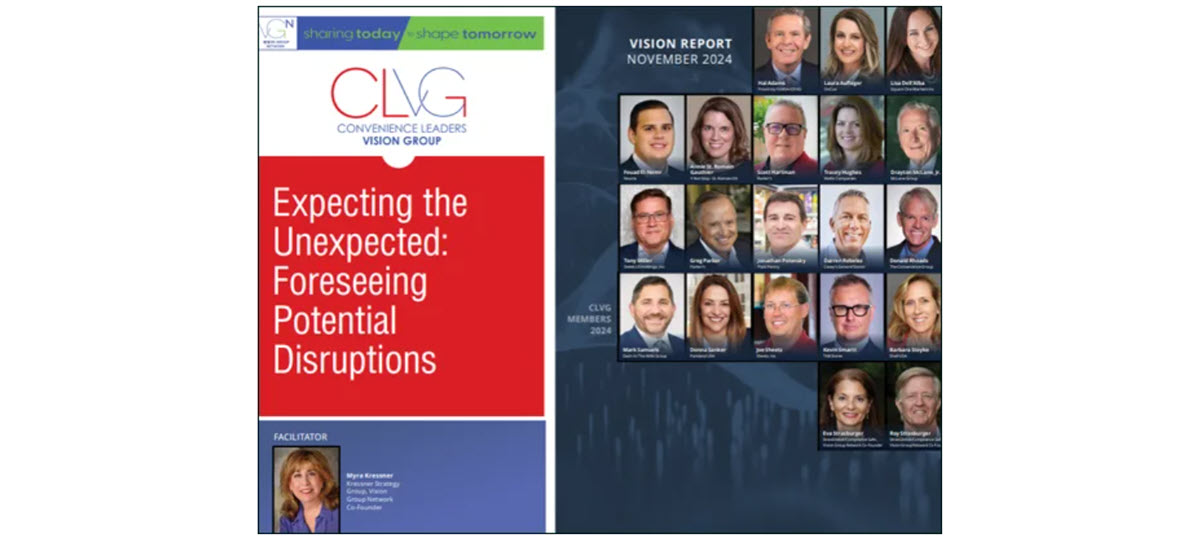

The Convenience Leaders Vision Group (CLVG) released its newest Vision Report, “Expecting the Unexpected: Foreseeing Potential Disruptions,” covering a range of challenges facing the convenience retailing industry ranging from emergency and cyber preparedness to societal issues such as unrest, healthcare and more.
Key takeaways from the candid discussion highlighted the necessity for retailers to remain alert, adaptable, and prepared for evolving challenges. Members stressed how critical it is to keep these potential disruptions front and center for the industry, including sharing best practices. Embracing a proactive mindset and fostering continuous learning will be vital as businesses navigate these complexities in the future.
The report features an executive summary of the meeting, the full meeting transcript, and additional resources for further exploration of the topic.
CLVG’s October 1, 2024, quarterly virtual meeting was facilitated by Myra Kressner, Vision Group Network Co-Founder and President of Kressner Strategy Group. CLVG members and their invited guests dug deep into topics that most retailers face, including potential disruption from weather emergencies, cyber threats, social unrest, supply chain disruption, the next global health crisis, and the rise of appetite suppressant drugs.
As member Don Rhoades, president and CEO of The Convenience Group expressed: “This is really key, having a group discuss a really important issue, one that obviously affects much of what you do day in and day out, and find a common theme here that we can all use as a best practice.”
Topics in the report include:
Emergency Preparedness
Having an established plan remains a critical focus for businesses facing the realities of natural disasters. The emphasis on comprehensive emergency action plans, thorough employee training, and the installation of emergency generators stood out as essential strategies for minimizing damage and maintaining operational continuity.
As Greg Parker, founder and CEO of Georgia-based Parker’s relayed after recent hurricanes ravaged his area, “It’s nothing like having something like this go on when you can really have a chance to say, what did we do right and what did we do wrong? What do we need to improve for the next one?”
Cybersecurity Preparedness
The lessons learned from the recent world-wide CrowdStrike IT system outages serve as a stark reminder that retailers of any size can face significant challenges with cybersecurity. Implementing robust business continuity plans and preventative measures like multifactor authentication is crucial for mitigating risks and ensuring organizations’ resilience in the face of potential cyber threats.
“It’s the thing that keeps me up at night and it’s something we’ve made major investments in. And thankfully we haven’t had any issues, but I also know that even with all that preparation, all the money we spent, it can still happen. And so you just have to be, I think, mentally prepared for it and not think that just because you did X and Y, you’re good. So you just have to constantly check yourself and challenge yourself,” said Jonathan Polonsky, CEO of Plaid Pantry in response to his company’s cyber preparation.
Facing the Possibility for Social Unrest
As community partners, members highlighted safety challenges convenience store workers face amid social unrest. Key strategies include extensive employee training in de-escalation techniques and crisis management, alongside proactive communication and listening to frontline staff. Balancing employee safety with community service is vital as stores remain essential resources during crises.
CEO of StrasGlobal, President of Compliance Safe and Vision Group Network Co-Founder Roy Strasburger articulated a sentiment shared by many in the meeting that “Our folks need to protect themselves first. They need to protect our assets second, and then they need to try to provide the best customer service they can after that.”
The Next Pandemic and Supply Chain Disruption
With ongoing supply chain concerns compounded by complications of driver shortages and logistical bottlenecks, members stressed the importance of preparedness. With lessons learned from COVID-19 and acknowledging the challenges of maintaining public trust and adapting to future crises, especially with potential new pandemics, most agreed that the unpredictable nature of future threats makes comprehensive preparation difficult.
As contemplated by Kevin Smartt, CEO of TXB Stores: “There were some key learnings for us in COVID, and I think some of those things we would fall right back into immediately…We were talking about this just the other day, not thinking about preparing for it, but just thinking about the uncertainty when the pandemic started…trying to think about what you might need if something was to occur again, not knowing what the risk would be that’s hitting the public, I think is like a dart throw. But I think having good preparedness plans, like we started off talking about in case of a disaster, I think is really critical. And probably brushing off and keeping those up-to-date would be important.”
Appetite Suppressant Drugs and the Possibility of Shifting Product Sales
The impact of weight-loss/appetite-suppressant drugs on consumer behavior and public health emerged as a potentially transformative trend. These medications have the potential to alter eating habits and disrupt traditional consumption
patterns in the convenience store, grocery, and fast food industries. This shift might signal the need to reevaluate product offerings to align with changing consumer preferences and health outcomes.
“We’re in an industry which is around snacking and around fast food. How are people preparing for how that might change?” questioned Eva Strasburger, president of StrasGlobal, CEO of Compliance Safe, and Vision Group Network co-founder.
To download this and other Vision Group Network Vision Reports, please CLICK HERE.