
By Keith Reid
It’s hard to underestimate the role the United States oil industry played in the Allied victory in World War II, though it can be overlooked. The role the U.S. manufacturing base played in the victory is well documented. Tanks, planes, ships, trucks, guns, artillery—you name it. If it was useful for the conduct of war, the United States not only produced enough to meet America’s needs but with sufficient abundance to help meet the requirements of every ally in the conflict.
However, all of those aircraft engines needed fuel, and the country delivered both in quantity, quality and raw performance.
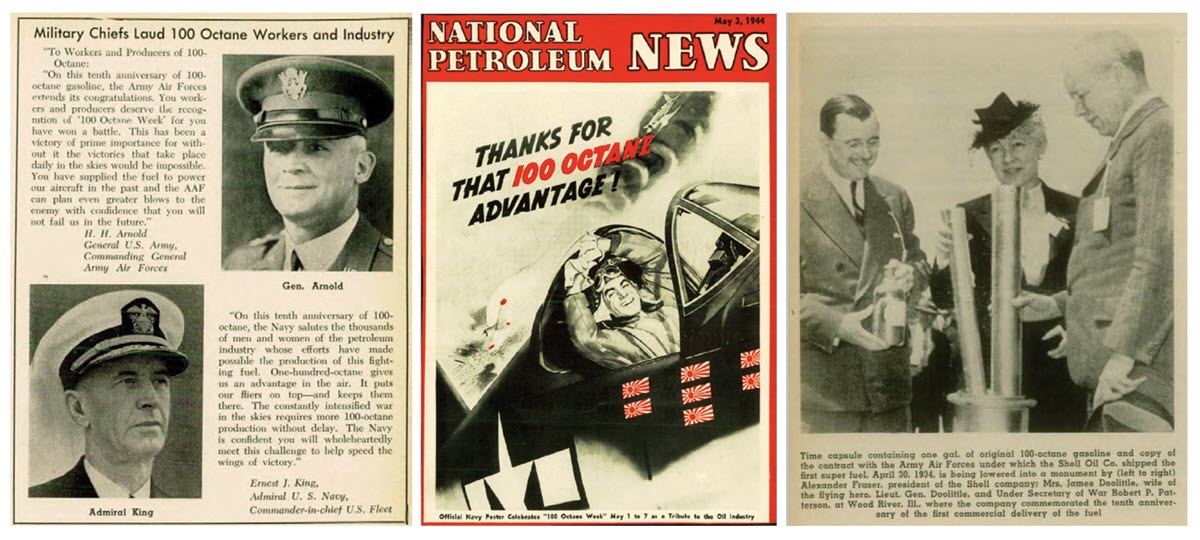
The May 3, 1944, issue of National Petroleum News highlighted the official government recognition of “100 Octane Week,” which was held May 1-7 as a tribute to the oil industry. While the United States had been able to more than meet the fuel volume requirements, this tribute acknowledged the quality component.
The effect of this fuel first became apparent before the United States entered the war during the Battle of Britain, when U.S.-supplied 100 octane fuel began to replace British fuel in the 81/87 octane range. This fuel combined with the British Rolls Royce Merlin XII engine fitted in the Mark II Spitfire allowed an increase of roughly 330 horsepower. From a speed standpoint this could represent a significant 35 to 45 mph.
There were several articles in the issue covering 100 octane fuel. It was noted that this fuel was first produced 10 years previously by Shell at the Wood River, Illinois, refinery. While it didn’t have a consumer market, the military aviation market made it worthwhile to produce despite its significantly increased production costs. By May 1944, 100/130 octane fuel was being produced at a rate of roughly 400,000 barrels per day, which was more than sufficient to meet the needs of the war effort.
Two military leaders at the forefront of the air war lauded the oil industry.
From the US Army Air Forces side: “On this 10th anniversary of 100-octane gasoline, the Army Air Forces sends its congratulations. You workers and producers deserve the recognition of ‘100 Octane Week’ for you have won a battle. This has been a victory of prime importance for without it the victories that take place daily in the skies would be impossible. You have supplied the fuel to power our aircraft in the past and the AAF can plan even greater blows to the enemy with confidence that you will not fail us in the future.” —H.H. Arnold, general U.S. Army, commanding general, Army Air Forces
And from the Navy side: “On this 10th anniversary of 100-octane, the Navy salutes the thousands of men and women of the petroleum industry whose efforts have made possible the production of this fighting fuel. …. The constantly intensified war in the skies requires more 100-octane production without delay. The Navy is confident you will wholeheartedly meet this challenge to help speed the wings of victory.” —Ernest J. King, admiral U. S. Navy, commander-in-chief, U.S. Fleet.
What was not mentioned, likely because it was still considered to be a military secret, was the fact that the United States was beginning to supply the European theatre. This fuel was aggressive on rubber components and spark plugs and it shortened engine life, but by that point in the war there was no shortage of engines, and the performance gains were worth the downside.
 Keith Reid is the editorial director of Fuels Market News.
For more than 100 years, from its founding in 1909 to when it went out of business in 2013, National Petroleum News (NPN) documented the rise of petroleum marketing and retailing in the United States. NACS, PEI and The Fuels Institute have catalogued the rich history of NPN in its entirety. Each issue of Fuels Market News will look back at the history of our vibrant industry, through the eyes of NPN, to see how it reflects the issues, challenges and opportunities we face today.