
The United States road transportation sector accounts for 22% of US greenhouse gas (GHG) emissions. Policies have been put in place to reduce emissions in the road transportation sector—both on a federal and state level in the U.S., as well as around the globe. Many decarbonization technologies are available and are being incentivized under such policies, each facing a unique set of challenges as they are deployed commercially. Among these options, e-fuels (or synthetic fuels) are a renewable technology that can be used in existing and new vehicles while potentially yielding near-zero emissions.
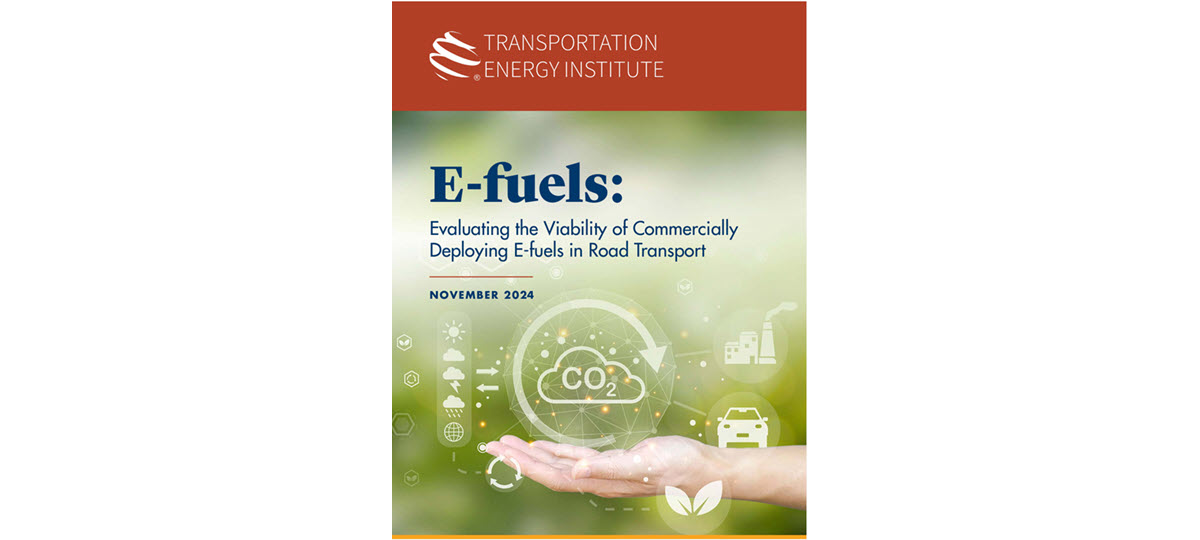
The Transportation Energy Institute (TEI) has issued a new report, Efuels:Evaluating the Viability of Commercially Deploying E-fuels in Road Transport which evaluates the viability of e-fuels in the U.S., based on their current technical suitability, emissions reduction potential, scalability and economic competitiveness, and how this could change by 2040. It focuses on e-fuels’ potential contribution to the sustainable transition of the road sector and other transport energy sectors.
“To achieve our global environmental objectives, we must find ways to reduce emissions from existing and new combustion engine vehicles and e-fuels could be one way to that. To contribute meaningfully to decarbonization across the transportation sector, e-fuels will have to become commercially available and be deployed at large scale,” states John Eichberger, TEI’s Executive Director. “This will depend on technical progress, feedstock availability in particular locations, availability of funding, strong policy support, and the speed in which other transport decarbonization options ramp up. Our new report evaluates the potential of this market and what will be required for it to become a significant contributor to the transportation sector.”
Some key points covered in the report:
- To achieve global decarbonization objectives, reducing the greenhouse gas emissions from internal combustion engine vehicles that are currently on the road and that will be sold in the future will be essential. There are 1.5 billion vehicles in the world today with tens of millions more sold each year. A lower carbon intensity fuel is the only path to mitigate their emissions and new fuel options will be required.
- E-fuels produced for on road transportation vehicles are considered drop-in fuels and can be used just as the market currently uses gasoline, diesel and biofuels, without modification of vehicles or equipment.
- E-fuels could close potential emission reduction gaps or accelerate emission reduction efforts in road transportation in the U.S. By leveraging renewable electricity, some e-fuel production pathways could produce drop in fuels for on-road vehicles with a 75% reduction in life cycle greenhouse gas emissions compared with fossil gasoline.
- Whether e-fuels will be supplied to the road transport sector in the U.S. will be largely influenced by policy. Currently, e-fuel production is very expensive and not competitive with other fuels. However, when considering current U.S. policies and global production expectations over the next 15 years, some e-fuels could become competitively priced.
- By 2040, given the expected increase in commercial production facilities, e-fuel production in the U.S. could increase to 4.7 billion gallons and globally to 27.5 billion gallons.
- The strongest demand signals for e-fuels come from the aviation sector but e-fuels could be supplied for both aviation and road transportation.
- E-fuels are (and will continue to be) more expensive to produce than their fossil counterparts, making policy support critical for projects to be economically viable.
- Further policy drivers are needed to provide additional confidence for investments in e-fuels and to support their uptake.
To achieve global decarbonization objectives, reducing the greenhouse gas emissions from internal combustion engine vehicles that are currently on the road and that will be sold in the future will be essential. This new report delves into why e-fuels are an important option and how it can accelerate emission reduction efforts.
For in-depth details, a top line overview and abridged summary, download here.