
Selling fuel in California takes the word ‘challenge’ to the next level.

Tom Robinson
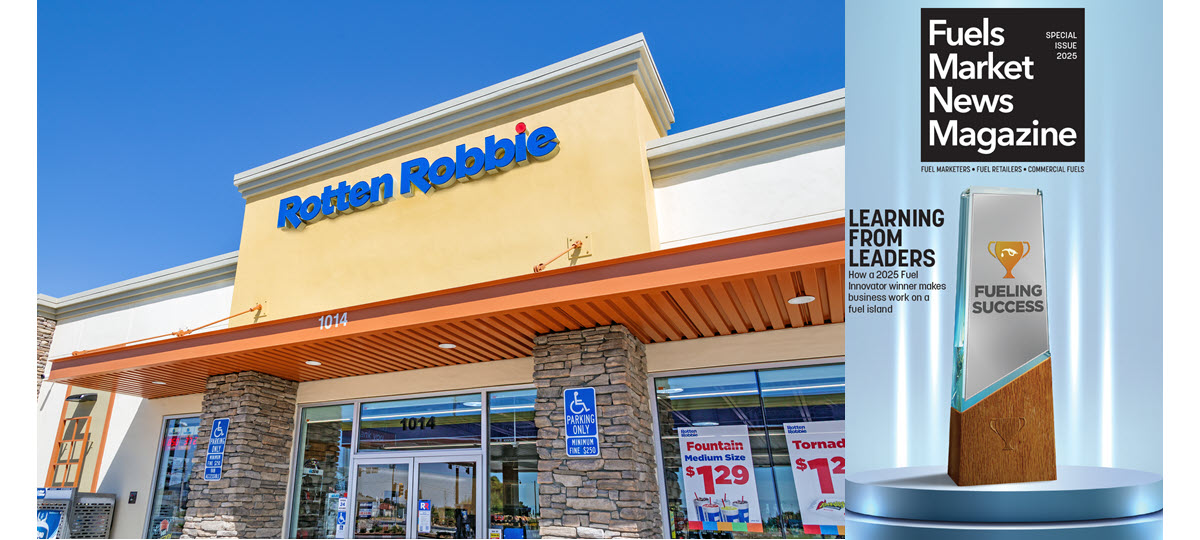
Fuels Market News presented the 2025 Fuel Innovators of the Year awards to Rotten Robbie (for a retailer with fewer than 100 sites) and QuikTrip (for a retailer with 100 or more sites) at the NACS Show on October 14.
Accepting the award for Rotten Robbie was Tom Robinson, chairman of Robinson Oil Corp. Tom is a past chairman of past president of SIGMA and past board member of the California Independent Oil Marketers Association.
Robinson Oil’s Rotten Robbie is a fourth-generation Northern California retailer with a history dating back to the 1930s. It operates 39 locations with a focus on quality fuel at good prices, and a solid convenience offer in the store. Rotten Robbie has offered biodiesel since 2008, has explored EV charging and now offers premium renewable diesel. On the commercial side the company provides fuel management solutions for small to large business fleets, over-the-road transportation companies and government agencies. It further works with the national fleet fueling programs. Pacific Pride, CFN and Fleetwide.
QuikTrip was unable to accept the award in person but submitted an acceptance statement.
Robinson participated in a lively Q&A session with Keith Reid, editor of Fuels Market News.
What are some of the challenges you face in California?
We don’t have as many c-stores as some other states, so it’s less competitive in some respects. At the same time, there are so many regulations and costs to cover that I had to make a list.
I don’t think any other state still has Stage 2 vapor recovery. We have enhanced vapor recovery, which means that if it gets out of sync it goes into alarm and then we’ve got a problem. And now with all the canisters in cars, you have fugitive emissions. In most states, if somebody drives off with a nozzle, the cost to replace hoses and breakaways would be a couple hundred dollars. But in California it’s about $700 to replace everything.
We have higher excise taxes than most states. Not only that, but we have greenhouse gas initiatives, and we have the low carbon fuel credits. It’s not called cap and trade anymore; it’s called cap and invest—which I think really is just cap and spend some of those dollars on the bullet train or whatever.
Most of the cities that we’re in have passed higher minimum wage laws, so our wage rates are higher than virtually anywhere else. We have various tobacco bans and menthol bans. Santa Cruz is working on a filter ban because they don’t want to have filters on the beach.
We have the California Environmental Quality Act, which basically means you can stop any project for almost any reason that you want. Obviously, the rules on refiners have rapidly discouraged refining in our state. California always had volatility, and it’s always going to have volatility because it’s a fuel island with special fuels. And, of course, our governor decided that he was going to ban internal combustion cars in 2035. There’s been a rollback at the federal level, and we’ll see how that plays out. But that’s certainly a big deal.
Other than that, California’s a great place and we truly have the best weather in the United States. But it’s an interesting place to do business, let’s put it that way.
How does the customer look at high fuel prices in California?
California fuel buyers are always paying $1 to $2 more than the average price in the rest of the country, and it absolutely amazes me they don’t complain about that more. I think it’s partly because our borders don’t have a lot of population. So, it’s not like you can easily cross the border to save money—no one in the Bay Area or in the LA Basin is going to go out of state to get fuel.
Also, our prices, from high to low, can range in price from 40 cents to a dollar. Certainly, some of the branded locations are competitive, but with the private brands everybody’s fighting over a couple of pennies. No one is giving anybody any extra room. So, we have consumers that will pay a lot at some locations, and yet you can also see the classical shift for a couple of pennies or a nickel a gallon, which is an interesting phenomenon when you’re trying to figure out how to price.
A lot of retailers really promote their store offers, but you promote the fuel side of your business as much—if not more.
For us, and I think in general for California retailers, we are very fuel dependent. The stores alone will not carry us if the fuel doesn’t work out. Historically, we had some challenges. Our legacy locations, which were generally built in the ’60s, mostly tend to be on smaller lots. And back in the 1980s when Mothers Against Drunk Driving pushed that it was bad to sell gasoline and sell beer at the same place, cities were able to ban gasoline and beer sales, and we couldn’t get that turned around until the early 2000s. Fuel has been—and continues to be—the most significant part of our business.
How do you manage your wholesale, commercial and retail businesses?
For a long time, we’ve been a private brander, and along with that we’re in the commercial fueling business with Pacific Pride and CFN. That compliments what we’re doing with fuels. We buy at the rack and at the pipeline. Our operations are concentrated, which makes that relatively easy since we only have a few terminal clusters.
Give us your take on demand destruction.
It’s certainly expensive building new facilities—that’s a challenge. But there’s also a lot of people that are really doing a great job of building new facilities. The good ones are gaining, the pretty good ones are maintaining and the ones that are less good are losing. When I look at what we’re going through and what those in my study group are experiencing, most of them are just dealing with the normal stuff that they’re worried about—turnover and those kinds of things.
How has renewable diesel worked out for you?
Adopting renewable diesel was driven by the credits for low carbon fuel or for cap and trade. I think the new producer’s credit for bio has messed that up a bit. Between CARB diesel and renewable diesel, it’s sort of a push. You’re starting to see some folks back out of renewable and going back into CARB.
Renewable is a refined biodiesel that refiners produce. You can ship it through a pipeline. It’s a great product. Probably the only challenge is you can have starting issues in cold weather—more than petroleum diesel—but that’s not much of an issue in California. CARB diesel is also a good product with higher CETANE and other positive attributes.
What about EV charging?
EVs have been a disaster for us. We’ve had some incentives, but it’s been expensive for us. Our vendor went bankrupt, and they wanted to charge us for the ongoing maintenance of these units. The cost was an order of magnitude greater than what we were getting in gross revenues. And charging’s a little bit different for us because an awful lot of our locations are suburban; we’re generally not on the interstate where you really need charging.
What role has technology played in your operation?
We’ve kept up with the advancements in the industry. I remember sticking tanks. The way that you monitored your tanks in earlier days was inventory reconciliation. Now you have equipment that does that. When we had a price change, I remember having to go to every pump. We still change our price signs locally, which a lot of people don’t.
One notable change is the programs that we use to dispatch fuel. I can remember dispatching fuel with pencil and paper and it’s so much easier now to figure that out. These things are not new technologies, but they have been significant enhancements through the years.
Today, I’m interested in how people are using AI. Our HR manager uses it for new hires.
How have things changed and how do they remain the same?
 Anybody that started in business 30 or more years ago wanted to have either “petroleum” or “oil” in the name because they wanted to be associated with these big oil companies. And now, some want to de-emphasize the fact that they sell petroleum products.
It wasn’t that long ago that you had gas stations without stores and stores without gas stations. You still have some of that, but the marriage of the two has been impressive for our industry—not to mention the size of the stores and the foodservice programs. There was a time when a 2,400 square foot store was standard, and now they’re a lot bigger.
We’ve gone through waves of consolidation at all levels. Companies like Circle K and 7-Eleven are massively large. And it wasn’t too long ago that QuikTrip was probably a couple hundred stores.
The upstream guys are very consolidated. And not only have the integrated oil companies consolidated, they’ve sort of disintegrated. They separated their upstream from their refining and marketing. And a lot of them, if they had their own company ops, they got rid of those, too.
The other thing that was a big deal was the shale revolution. During that period our increase in production was greater than the production of any OPEC country except Saudi Arabia. When he had the financial crisis, that was one of the few industries that did well. And after that we haven’t had the same crude oil spikes that we used to have. The only spike we had was the Ukraine War, and that was short-lived.
I can remember selling gasoline for $0.26. I can remember it going over a dollar, and then over $2.00. But the one thing that has not changed is being competitive. People are fighting to gain a few more gallons. It’s been a great business, and it just continues to amaze me.