

With the right effort and focus, you can run a small business in some very big ways.
By Keith Reid
Leading businesses in the retail fueling and convenience industry come in all shapes and sizes. On the smaller end of the scale—a single site operator in fact—is 36 Lyn Refuel Station, which is owned and operated by Lonnie McQuirter. Located in metropolitan Minneapolis, the operation serves a highly diverse community with a range of store products and solutions both inside the box and out on the forecourt.
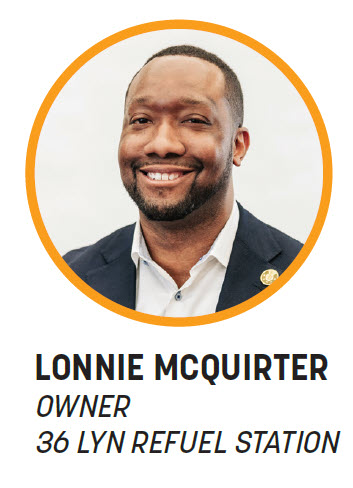 McQuirter is the very definition of a small business entrepreneur. However, he is also involved in the industry at large in the same way you might expect to see from a CEO at a larger company.
After a stint at Haagen-Dazs, McQuirter has worked at 36 Lyn Refuel Station as the owner/ operator since June 2005, when it was launched with financial support from his family. He is currently on the board of directors at both NACS and Conexxus, and in 2018 he served as chairman of the Minnesota Retailer’s Association. McQuirter also serves on the Southwest Business (Minneapolis) Association Board and was honored as the Volunteer of the Year for the Lyndale Neighborhood Association. 36 Lyn Refuel Station is a member of the National Retail Federation and is also a three-time Inc. 5000 honoree and a onetime MSPBJ Fast50 honoree.
FMN and McQuirter discussed the challenges and opportunities that come with being a single-site operator in the industry today.
IN AMERICA, THE LAND OF OPPORTUNITY, THE EDUCATION SYSTEM SEEMS TO PUSH BECOMING AN EMPLOYEE OVER BECOMING AN ENTREPRE[1]NEUR. WHAT DROVE YOUR ENTREPRENEURIAL SPIRIT?
I’ve always had a very entrepreneurial mindset. My dad was always self-employed, and for me, that was the only way I’ve known things. Many people look at athletes or movie stars for role models, but for me it was a lot of the business professionals that I had the pleasure of being around as a kid and into my adulthood.
Entrepreneurship is an abstract concept and foreign to most people, because the only way that they’ve known is how to sell themselves to an employer and how to stay employed, and looking at the world from that vantage point. But that’s foreign to me. I’m terrible at interviews and I’m terrible at trying to sell myself, but I’m good at selling things in my business. I’m good at getting a feeling for where my customers are going and trying to understand where the economy’s going. There have been times where I’ve flirted with the idea of leaving and going to work for someone, but I’ve found it much more fulfilling to operate a business.
In addition to the store, I co-own a co-packing facility and some retail properties. And, as the opportunity presents itself, I will consider expanding the convenience business.
WHAT WERE SOME OF THE CHALLENGES YOU FACED GETTING OFF THE GROUND?
How much time do you have? In 2005 I struggled with just about everything and I had to prioritize, because being a small business opera[1]tor means you can’t throw money at everything and it’s the same with your time. You must really focus on what can move the needle. Those small increments compound. Many people focus on those silver bullets and home runs, and they ignore the base hits. That may be LED lighting or HVAC improvements, and it is particularly the case with considering investments in technology.
LABOR IS A HUGE ISSUE FOR THE INDUSTRY. HOW DO YOU MAXIMIZE THAT ASPECT?
Hiring talent has been important to me from the get-go, first with the process and then keeping them engaged in the workplace. We value our employees—we really do care about them— but there is some self-interest in that. We start with a pre-interview, since having a bad employee can burn a huge hole in your pocket. I’m in a higher labor state, and it’s expensive to hire and it’s expensive to fire—it costs me about $17,000, and that’s real money that’s now gone.
We want to make sure we have consistency throughout the whole process, and that’s easily quantified. For example, we can look at turnover and I can say that we’ve had about four people that we’ve lost mainly because we didn’t onboard them properly.
You can start to build a track record to get an understanding of the employment journey from when you hired someone through the initial training to coaching and look at things and say, “What’s making these employees bad? Or what’s giving them reason to leave?” Do we need to change the way we are hiring, the way we’re coaching, the way we are doing the hands-on training or even some environmental aspect of it?
Do we need to address our business hours? Do we need to shorten the shifts? That’s something that we’ve been playing around with.
WHAT DOES TECHNOLOGY BRING TO THE TABLE FOR THE SMALL RETAILER? CAN IT ADDRESS THE ECONOMIES OF SCALE FOUND WITH LARGER OPERATIONS?
The improvements in computing power can begin to quantify and track and measure things that would have been very difficult to do previously, especially if you’re one person, a jack-of-all-trades, wear a thousand hats type of person like me.
With technology, you can look at things more objectively as well as execute on a more consistent basis. And that’s really the opportunity that the small operator has right now, making great strides with having the same high standards or consistent offerings as with many larger retailers, whether it’s monitoring inventory levels or uptime and downtime, etc.
You can drill down into your hourly sales and analyze how you’re budgeting your labor, which can be very important—especially for foodservice. You can maximize your sales and make sure you have a consistent offering through all parts of the day to build more of a chance to earn their business.
WHAT ABOUT SOCIAL MEDIA AND ONLINE PLATFORMS?
A lot of business operators look at something like Google Business or Yelp and get upset because there may be some things that are said that are embellished or not entirely true.
But that customer is reaching out to say, look, something’s off here. I’m not sure exactly how to articulate it, but something’s off that you need to address.
I’m always grateful for those one- or two-star reviews because that’s a learning experience. When you can pinpoint it down to the employee, it gives us some things to work on. And it takes the subjectiveness out of the relationship between you as the manager or business operator where sometimes people might take it personal otherwise. That is extremely helpful.
Social media, Instagram or Facebook or X, are also great barometers. On X [formerly Twitter], I used to be able to run scripts there to pull data out in different ways, which gave me an idea of the sentiment of consumers, though that’s harder now. I also use TweetDeck quite a bit as a way of monitoring news flow or following certain accounts in a manner that lets you focus on specific topics or issues. And so you can kind of monitor what’s going on there. That was helpful in 2020 during the unrest here [after the death of George Floyd], and it’s helpful today when it comes to looking at things like what’s going on with oil.
WHAT ARE YOUR CURRENT FUEL AND ENERGY OFFERINGS?
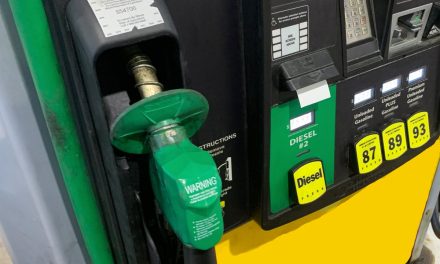
We currently offer the three standard grades of gasoline, and our DC fast charger which we installed in 2015 and are considering upgrading. We are looking strongly at renewables, such as ethanol, through some state and federal programs. That will entail the replacement of our dispensers as well as doing some tank work.
In 2015, we took part in the #24EVChallenge which was a run by The Guinness Book of World Records and attempted to charge 100 plug-in EVs in 24 hours. We think we met the challenge unof[1]ficially, but technically we charged 85 vehicles. Since 2014, we have also operated the store on wind energy.
ARE YOU BRANDED OR UNBRANDED?
We are branded 36 Lyn Refuel Station. We are no longer affiliated with a major oil company after the BP Deepwater Horizon platform oil spill in 2010. The community had a lot of questions, and we didn’t feel like we received a lot of support from the major oil company. I realized I needed a change. We have Top Tier on the 93.
WHAT ARE YOUR THOUGHTS IN GENERAL ON BRANDED VS. UNBRANDED IN THE MARKETPLACE?
I look at those smarter and bigger than me. So, I look at companies like Sheetz, Wawa, the trips— QT or KT—Circle K … they’re all branded with their own fuel. I recognize there can be a differ[1]ence in fuel quality, but I also recognize that my customers don’t value that as much as they value the lowest price or other ways that they’re looking at value when it comes to what they’re putting into their tanks and where they stop to fill up. I think a lot of that is how you go to market and how you lay out your store and your store design.
YOU ALSO HAVE A FOCUS ON OFFERING THE COMMUNITY HEALTHY FOOD ALTERNATIVES.
One of the things that I’ve observed since I’ve had the store is you may have a customer walk in and they’re looking desperately for something that’ll fit their healthy food desire. They’re not finding what they’re looking for and then they settle on something that’s not their first choice, like a bag of chips or a candy bar. Being able to suit that need when it comes to healthy items is an opportunity for convenience stores and if we’re not careful we may lose that space.
Customers were asking for it and—being an enterprising individual—if someone’s trying to give me their money it’s my job to figure out how I can take it from them. It’s better to have a bottom-up approach, paying attention to what consumers are requesting, and looking at the local trends. Over half of our item mix is locally sourced and organic at this point.
BUILDING ON THAT, ONE ADVANTAGE A SMALLER OPERATION HAS OVER THE LARGER CHAINS IS THE FLEXIBILITY TO MEET THOSE SPECIFIC CUSTOMER NEEDS. YOU OPERATE IN A HIGHLY DIVERSE COMMUNITY—AGE, RACE, INCOME AND RELIGION. HOW DO YOU MAXIMIZE YOUR OPPORTUNITIES?
There are different social norms with different groups. They may articulate certain feelings in a manner different than the way you or I do, and at times it may come across as off-putting. It’s just a failure to comprehend those cultural differences. You can hire people from those cultures to help understand those differences better.
We have a large Muslim population as well as a large Christian Hispanic population. Both can be very conservative socially (not politically). We also have customers who are very liberal socially. We’re in kind of a melting pot in Minneapolis in many ways, where depending on how things are said and who says it, it could be a compliment to someone or it could be offensive, so you must navigate that.
It does give you a lot of options when selecting products, but even there you must be mindful. For example, with our Muslim community, there are products we won’t set next to each other. If you are a large regional or national brand, it could be more challenging to make sure that your planograms accommodate halal and kosher products or to market those products in such a way that makes it easy for that customer to identify them on your shelf.
WHAT DO YOU THINK ARE SOME OF THE BIGGEST CHALLENGES YOU FACE AS A RETAILER TODAY?
I’m spending a lot more time dealing with political or regulatory issues. It’s challenging at times when you’re dealing with policymakers and they think we’re further along in our tech cycle or more sophisticated than we are. And sometimes they think that we’re making more money since we are in the private sector, and that we can implement all of these changes that they’re looking for.
Some of that may be employee/employer relations. Some of them could be environmental practices, whether we’re talking about food waste or bans and prohibitions on certain products. But that’s a real challenge there.
EVEN AS A SINGLE SITE OPERATOR, YOU ARE VERY INVOLVED IN INDUSTRY ORGANIZATIONS LIKE NACS, CONEXXUS AND TEI AND TAKE TIME OUT FOR DAY ON THE HILL EVENTS. WHAT DRIVES YOUR INVOLVEMENT?
You can’t be complacent. As I discussed earlier, I believe our challenges are heavily political and regulatory in nature. One of my three favorite books is Only the Paranoid Survive, which was written by a former Intel CEO. I think there’s some good takeaways for convenience retailers in not being complacent and always looking over things and always trying to make incremental improvements that can make dividends. Being involved helps make that happen.
 Keith Reid is editor-in-chief of Fuels Market News. He can be reached at [email protected].