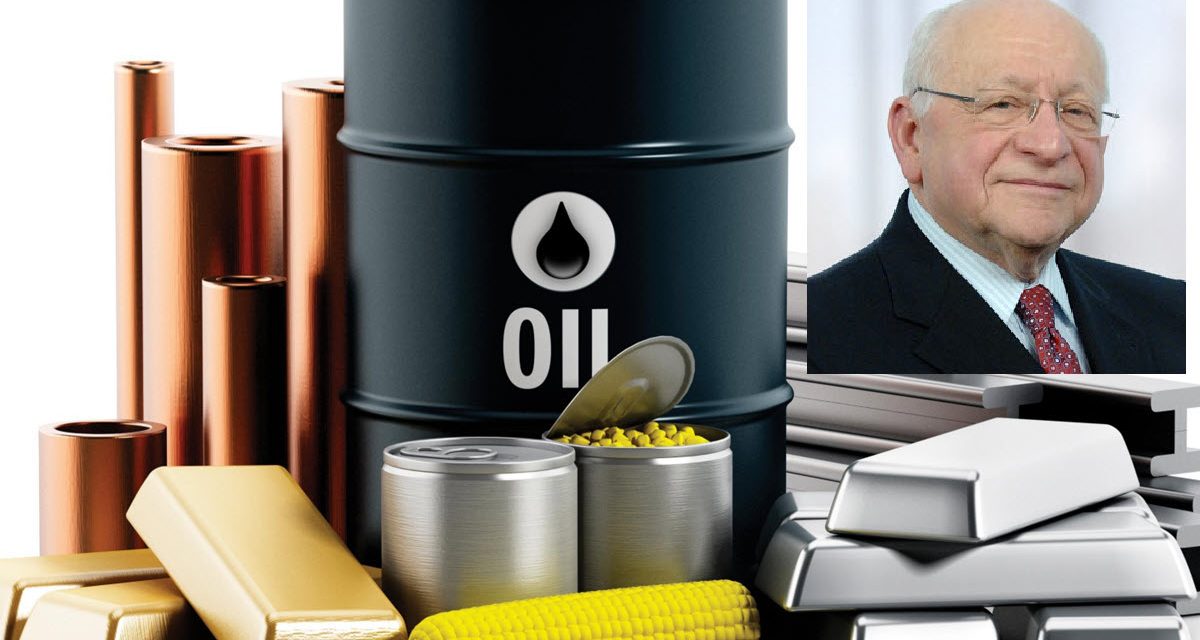

Alan Levine has been advising the industry on fuel hedging since he helped make it an option.
By Keith Reid
Alan Levine founded Powerhouse 11 years ago to offer clients consulting on the design and use of customer hedge instruments, as well finding counter parties for hedging transactions that cannot be satisfied with on-exchange instruments. He serves as chief executive officer and chairman, with Elaine Levine serving as president. David Thompson is executive vice president.
Powerhouse has been working with Fuels Market News since its founding and provides access to the Powerhouse Weekly Market Situation newsletter.
Levine is in many ways the father of fuel hedging and helped develop the initial New York Mercantile Exchange heating oil contract. Here, we look at his 40+ years in the industry, as well as the current fuels market, the value of hedging and his thoughts on the future.
Hedging itself is seen as a risk reduction exercise, or form of insurance, rather than a means to “gamble” with the market as might be the case with a “speculator.” It involves taking an offsetting position with financial instruments to protect against significant market swings, but at the same time might limit some opportunities for profit taking.
Levine was born in 1937 in Jersey City, New Jersey. His father was an electrician who provide a comfortable—but not posh—upbringing. After four years in an integrated high school where Levine had a “wonderful time,” he attended Rutgers University over the strenuous objections of his father, who believed college was a waste of time. For Levine, that only held true for his first major in marketing.
“The only interesting thing that ever happened in there was they took us on a field trip down to a place that sold workingman’s clothing—guys who worked on the railroad, plumbers, electricians and similar trades. They’d come in and buy overalls and so on,” Levine said. “It was a nice enough store, but it was all old wooden cases and stuff. Somebody asked the owner why don’t you get nicer fixtures? And the guy says, if I got nicer fixtures, I’d be out of business in a week because my customers would not be happy. They would be uncomfortable. Well, over 60 years later and I’ve never forgotten that story because history has proven that to be exactly the case.”
Levine was required to take economics, and an instructor convinced him to change his major and acted as an early mentor. He eventually earned a master’s degree from the Columbia School of Business.
Just days after graduating from Rutgers, Levine received his draft notice into the U.S. Army. He decided that the Navy was more his taste, and he entered the service as an ensign in 1960. His naval time saw him sailing the Pacific and crossing the equator to receive “shellback” status as the supply officer on the landing ship tank (LST) USS Wexford County. “It was exciting. It was interesting. It was fun. It was rewarding in so many ways,” Levine said.
During this time, he married his wife, Priscilla, a microbiologist, after an extended courtship dating back to 1953. They shortly had their first child, a daughter, Victoria, and later a son, Jason. After a stint ashore, he left the Navy for a job at Johnson & Johnson for a brief dalliance in health care before he discovered the world of petroleum.
How did you get into the industry?
Levine: I began in the industry in 1969. I worked for a fellow named Walter Levy, a well-known petroleum economist at the time. He had helped the major oil companies work through the difficulties of realigning their interests in the Middle East after Mohammad Mossadegh nationalized BP’s Iranian operations in 1951 and was then deposed by the CIA in 1953 and replaced by the Shah of Iran.
After seven years I left to work for several consultancies, and I soon went on from there to Washington, D.C., because in the early- to mid-1970s oil and gas were suddenly becoming important.
Around 1976 I joined up with an economist named Arnold Safer, and we set up a consultancy in Bethesda, Maryland, and developed a small but very nice business. But then the New York Mercantile Exchange was looking for another commodity to trade, and somebody came up with the idea of heating oil. So, we became their oil consultant and set up the first heating oil contract, and we continued to act as consultants to them, and we’d make speeches on their behalf. It was really the first contract of that kind in history.
The first trades were in 1978 and it was doing OK. Of course, in 1979 the Ayatollah Khomeini overthrew the Shah, and heating oil went from like 35 cents a gallon to $1.05. If you held a contract there you had yourself a pile of dough, and if you had 10 contracts, you had a real pot pile of dough. And there were people who had a hundred contracts. So, this was a very impressive thing. And you can’t keep a thing like that secret.
Arnold ran into some personal issues, and we decided to go our own ways. I joined Merrill Lynch in 1982, which had its own commodities company at the time. Over the years through acquisitions and mergers we became Dean Witter, which acquired Morgan Stanley and assumed that name shortly afterward. Elaine [Levine] had joined me by this time.
There was a lot of confusion in the marketplace and tension in the organization over the changes, and I almost came to blows over it with one of the guys from New York Morgan Stanley. I literally went across the table at him. This guy’s threating my life, my career, and remember I grew up in Jersey City and you didn’t put up with stuff like that. So, on Sept. 6, 2012, we left and established Team Levine LLC, dba Powerhouse. And we’re free of all the inhibitions we faced. Not surprisingly, we brought virtually all our customers with us.
Volatility always exists, but we are in a period of high volatility like we saw earlier in the 2000s. How do you see this playing out?
Levine: Well, the problem is I don’t know what’s going to happen in Ukraine. We’re now starting to impose limitations on Russian exports of crude oil. Of course, they’ll find ways to subvert this, but still it will have some impact. So, I think we’re in for a period of relatively high prices, up and down, depending upon what else goes on and until we get something that seems like a resolution in connection with the Russians. I think we are in for a period of tremendous uncertainty over the next several months. Then we have an election coming up, and I just can’t imagine how nasty that is going to be. I think we’re in for a long period of uncertainty and therefore relatively high volatility as well.
What size operation benefits from looking into hedging to stabilize volatility?
Levine: Everybody is exposed to market volatility. Now, some guys say, ‘I’m going to avoid that and buy fixed price.’ Well, that’s all fine, until you come to into a period when we’ve decided everything is cool and prices fall apart on you, and we’ve seen that happen. In 2008 we saw prices fall two bucks or more, and they were locked in at ridiculous prices—levels where a few of them are no longer in business and have been absorbed. I don’t want to sound trite, but I think there’s a place for everybody in hedging.
How can a lower volume operation take advantage of hedging?
Levine: The Merc with its 42,000-gallon contract is extremely important because it allows you to execute so fast. But if you’re smaller than that, we now have contracts available which are over the counter where we are doing a land office business with people wanting to do 35,000, or maybe it’s a 100,000, but they spread it out over eight months. So, they can’t use a standard contract. In addition to the many listed contracts that we could talk about, you also have over the counter. Even some of our biggest clients are using them if they have a specific deal that they don’t want to just average into their pricing and they want to keep it separate.
The idea of hedging can be intimidating for those without a financial background, which can encompass smaller operations. What would be an argument for those folk?
Levine: Well, if you’re exposed because it’s intimidating, how does bankruptcy hit you? How much more boldly can I put it? Ultimately, you get into a situation where your customers find themselves with somebody who is protecting themselves and can meet the market on pricing. If you can’t and you have to shut down for a period, what happens? What kind of business is that even for the big guys?
Do you need a lot of in-house expertise to hedge beyond what might be typical of the industry?
Levine: I would say it’s not been a difficulty. The customers we have don’t have big departments. The biggest companies don’t have that many people involved in their hedging operations. Even Southwest Airlines has relatively few folks involved in it, and Southwest has done very, very well with the hedging over the years.
Like everybody else we stopped in-person education. But in May we have the first of our renewed series on hedging training. And if you go there, you’ll learn everything from what’s a futures contract, an option, a long, a short and how you can use it in your business. Do you want to offer a cap? And if you do, how do you want to do it intelligently?
I first became aware of the usefulness of hedging relative to heating fuels, where fuel retailers wanted a stable price to offer their customer to heat a house over the winter. I assume you get into the same opportunities at the wholesale motor fuels side.
Levine: Those guys do all kinds of interesting things. Sometimes they’ll sell options to bring in cash so they can reduce costs. If you understand how futures, contracts and options on futures contracts work, there’s no end to what you can do. You can limit your own risk. You can define it. Of course, the more you define it, the less risk you have or profit you’ll make, too. But that’s also something that you have to understand. There’s no reward without some risk. If you’re so risk averse that you can’t handle any, you’re going to find yourself in a worst position because then you’re completely at the mercy of the markets.
What do you see looking to the future?
Levine: You remember George Orwell’s 1984? It divided the world up into interest blocks, and they were in constant conflict with each other. Now, everybody at the time said, this is ridiculous. We’re beyond that. We got into a more globalized world, where we are opening boundaries. There is the EU, and we’ve had that for decades. Now, it’s just kind of accepted that you can take a cargo from Spain and deliver it into Poland without much difficulty. That’s been a tremendous boom to European growth. And there was maybe the idea that we were in a new era and one where there would be no more [major] war. I think that is one of the reasons that the Ukraine situation is so particularly interesting at the present time. And then you realize you still have nutcases like Putin. And you see growing unease out of China. I’ve been trying to get everybody to focus on the fact that we may, in fact, not be having further globalization, and, if anything, perhaps the reverse.