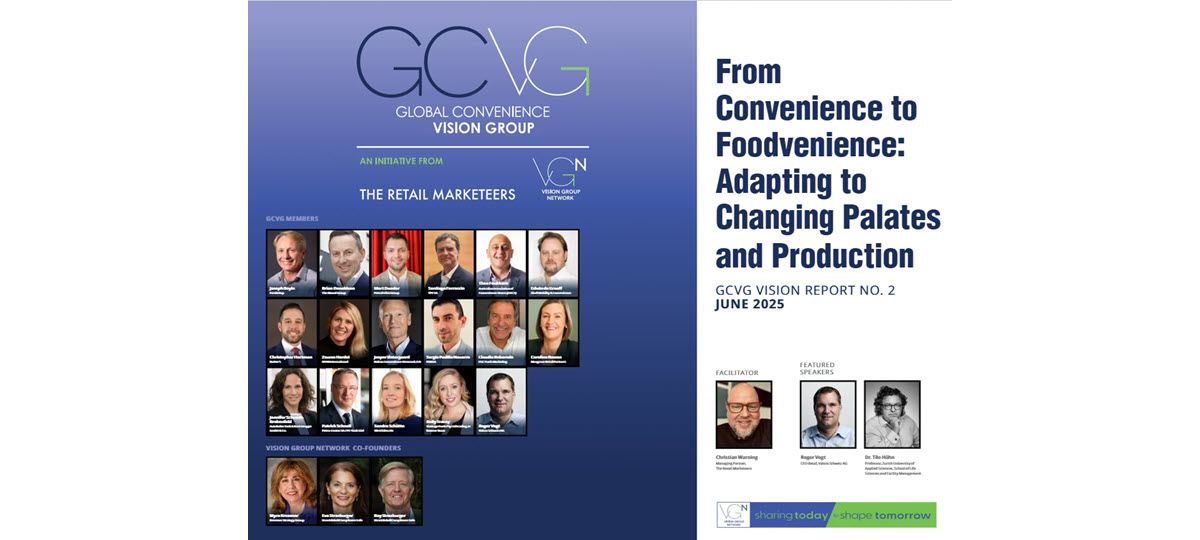

Global Convenience Vision Group (GCVG) has released its latest Vision Report, “From Convenience to Foodvenience: Adapting to Changing Palates and Production,” examining how health shifts, new production technologies, and changing consumer behavior are transforming convenience retail and foodservice offerings.
The latest GCVG quarterly meeting held on May 6, 2025, was facilitated by Christian Warning, founder and managing partner of The Retail Marketeers. The meeting featured two guest speakers: Roger Vogt, CEO Retail, Valora Schweiz AG, who shared insights on the company’s “foodvenience” strategy, and Dr. Tilo Hühn, professor at Zurich University of Applied Sciences, School of Life Sciences and Facility Management, who delivered a presentation on how pharmaceuticals like GLP-1 drugs and health trends are shifting food consumption patterns.
The Vision Report explores innovative approaches to combining convenience and foodservice, highlights the impact of health-conscious consumers on retail strategy, and examines groundbreaking food processing technologies that address both health demands and sustainability challenges.
Key takeaways in the report include:
- “Foodvenience” as a Growth Strategy for Valora: Valora Retail is seeing success by strategically combining convenience retail with foodservice offerings, creating more value for customers through integrated concepts. “The goal is to create more value for the customer by combining the know-how of both areas,” said Roger Vogt, CEO of Valora Retail, describing the company’s “foodvenience” approach. Vogt also discussed how the convenience industry is witnessing significant shifts in customer payment preferences, with self-checkout gaining rapid adoption in many of their markets. “It’s unbelievable. The share of people who use self-checkout is above 60%. So it’s unbelievable how they use that. And now we have a queue on the self-checkout, not on the cashier desk,” said Vogt, describing customer behavior at their Zurich location.
- Navigating the Changing Palate: Health Shifts, GLP-1s and the Sober Surge: The growing use of weight-loss medications like GLP-1 receptor agonists is significantly altering food preferences and consumption patterns, creating new challenges and opportunities for retailers. “[Approximately] 6 million people are using GLP-1’s in the U.S., and they estimate that around the end of the decade it could be 40 million or more. This will have a heavy impact on consumption profile of different foodstuff we find at the market,” said Dr. Tilo Hühn, professor at Zurich University of Applied Sciences.Hühn also shared that younger generations are shifting away from alcohol consumption, creating disruption in traditional beverage categories and opening opportunities for no and low-alcohol alternatives. “Clearly, the younger consumer today is a lot more health conscious than the majority of us were when we were at that same stage in our life…Will they maintain their views as they change [through] different stages of their life?” said Theo Foukkare, chief executive officer of the Australian Association of Convenience Stores.
- Adapting to Regional Differences in Convenience Expectations: Retail strategies must account for significant regional variations in how consumers perceive and use convenience offerings, from food theater concepts to innovative service models. “If I look in the streets, we’re picking up avocados on street markets, we’re picking up bananas on street markets. If I look at our differential and our supermarkets, it’s a theater of food,” said Joseph Boyle, CEO of FreshStop, describing the South African market.
- Healthy Demand Meets Economic Reality: Retailers face the challenge of meeting increased demand for healthier options while addressing cost concerns in a challenging economic environment. “It’s a very interesting equation because there is a demand, but who is willing to pay for it and who can afford those products, which are usually pricier than the mainstream?” noted Zsuzsa Hordai, head of strategic projects at SPAR International.