
Excerpted from This Week in Petroleum
Release Date: September 28, 2022
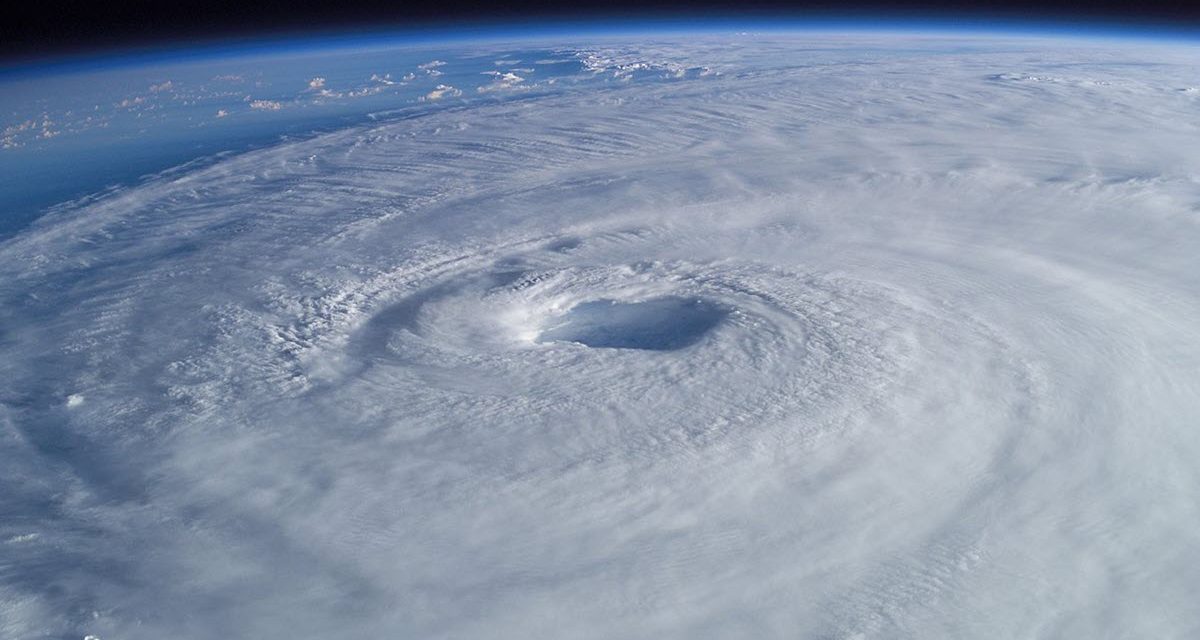
The National Hurricane Center forecasts that Hurricane Ian will result in strong winds and heavy rainfall in central and northern Florida this week, which could disrupt gasoline supply and demand in the state. Florida’s gasoline supply methods are unique compared with surrounding states in the U.S. East Coast region (PADD 1). Florida has no refineries or pipelines connecting the state to supply centers along the U.S. Gulf Coast (PADD 3). Therefore, unlike most other parts of the country, Florida receives most of its petroleum products by ship from domestic and international sources.
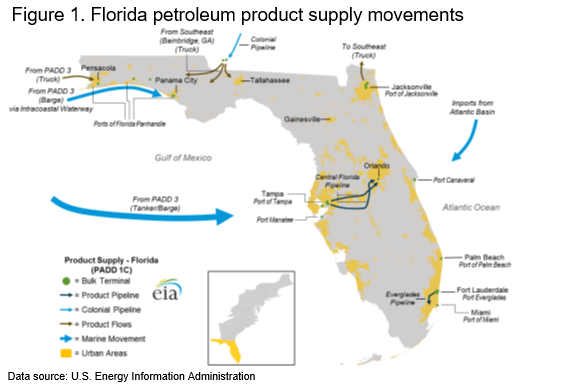
Florida’s gasoline arrives through several large ports located along its coastline, each transporting fuel to nearby markets via truck and short-distance pipeline:
- Terminals in the Port of Tampa supply much of the state’s western coast.
- Terminals in Port Everglades, just north of Fort Lauderdale, supply southern Florida.
- Pipelines from Tampa and some petroleum products trucked from Port Canaveral on the Atlantic Coast supply central Florida.
- Terminals in the Port of Jacksonville supply northeastern Florida.
The only petroleum product that enters Florida through a pipeline is sourced from a terminal in Bainbridge, Georgia, that is connected to the Colonial Pipeline system and supplies the Florida panhandle by long-distance tanker truck. The rest of western Florida is supplied by truck and barge via the Intracoastal Waterway from nearby refineries in Alabama and Mississippi (Figure 1). Refined product terminals in the Tampa area were reportedly halting operations on Tuesday evening in preparation for the storm’s impact on the city. Miami and Fort Lauderdale are also likely to experience delays in marine shipments in response to difficult weather conditions.
Florida is mostly supplied by shipments from domestic refineries along the Gulf Coast and supplemented with imports. In the first half of 2022, tanker and barge movements of gasoline from the Gulf Coast to the Lower Atlantic region (PADD 1C, or Florida, Georgia, North Carolina, South Carolina, Virginia, and West Virginia) averaged 414,000 barrels per day (b/d) (Figure 2). A large share of these movements went to Florida, and among Florida ports, the Port of Tampa typically received the largest volumes, according to our East Coast and Gulf Coast Transportation Fuels Markets Study. Florida also receives some motor gasoline imports. In total, about 491,000 b/d of motor gasoline was consumed in the state in 2021, based on motor gasoline prime supplier sales. As of June (the latest available state-level data), motor gasoline stocks (finished plus blending components) in Florida totaled 6.1 million barrels.

As of September 26, U.S. average regular grade retail gasoline prices were $3.71 per gallon (gal), up 6 cents/gal from the previous week (Figure 3). Prices in the Lower Atlantic region and the city of Miami, Florida, are typically lower than the U.S. average. As of September 26, prices for the Lower Atlantic region were $3.28/gal, down 2 cents/gal from the previous week, and prices in Miami were $3.36/gal, down 6 cents/gal from the previous week.

Other states in the Lower Atlantic region that could be affected by Hurricane Ian, such as Georgia and South Carolina, receive petroleum products produced at Gulf Coast refineries and shipped via pipeline. The Colonial Pipeline, which connects oil refiners along the coasts of Texas and Louisiana to demand markets in the Southeast and mid-Atlantic, all the way up to New York Harbor, is a critical source of supply for refined products along the East Coast. The Products S.E. Pipeline (formerly the Plantation Pipeline) is a similar, but smaller, pipeline that also moves petroleum products from coastal Louisiana through the Lower Atlantic as far as the District of Columbia. Moving products along these pipelines is generally less expensive than marine shipments, contributing to slightly lower average prices in the whole Lower Atlantic region compared with Florida alone. The state of Florida also has a higher gasoline tax than other nearby states in the region, at 35.5 cents/gal compared with 29.9 cents/gal in Georgia, 29.2 cents/gal in Alabama, or 28.8 cents/gal South Carolina.
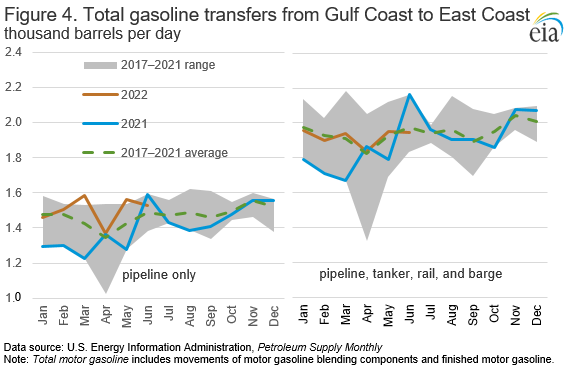
Total gasoline flows from the Gulf Coast to the East Coast were near the five-year (2017–2021) average in the first half of this year, while flows by pipeline were above average (Figure 4). Movements of gasoline by pipeline from the Gulf Coast to the East Coast accounted for 78% of all gasoline movements from the Gulf Coast to the East Coast. Gulf Coast pipeline movements alone also accounted for 50% of all gasoline consumed along the East Coast during that period.