
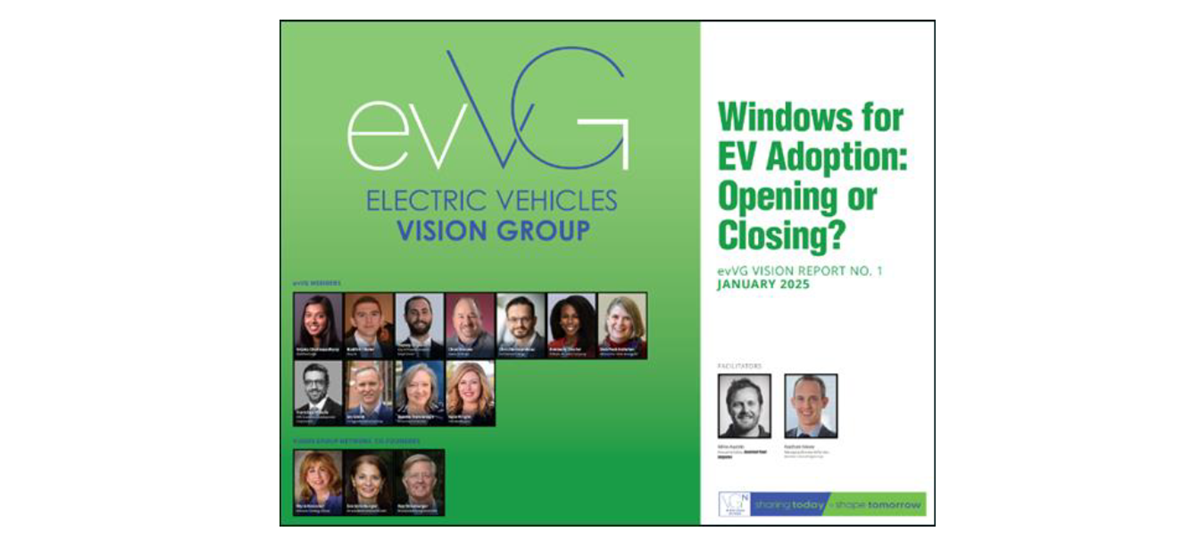

The Electric Vehicles Vision Group (evVG) released its first Vision Report, “Windows for EV Adoption – Opening or Closing?” The report features an executive summary of the inaugural virtual meeting which included a collaborative discussion on members’ perspectives on EV adoption and forecasting, the full meeting transcript, and additional resources for further exploration.
evVG’s first quarterly virtual meeting on November 19, 2024 was facilitated Mike Austin, executive editor at Road and Track Magazine and Nathan Niese, managing director and partner at Boston Consulting Group. evVG members include a diverse group of EV sector experts.
Key takeaways in the report include:
The Ripple Effect of U.S. Elections on EV Sector Growth
The implications for industries tied to federal and state policy was a timely topic with EV charging sectors feeling a heightened sense of uncertainty about their future. At meeting time, the new Trump Administration and policies had not yet begun to take shape and members speculated rollbacks of grant programs, policies and priorities which could take place.
“Let me put it this way, I’m not losing sleep over doom and gloom if incentives dry up or change or reuse. The industry is moving forward one way or another, and it’s not something I’d bet against regardless of who’s in the Oval Office or Congress,” stated Chris Normandeau, director at FirstService Energy.
State and Local Umbridge
States have been taking matters into their own hands focusing on the Clean Air Act and their individual abilities to set stringent emissions standards. States like New York and California were mentioned in terms of upcoming and future policies.
Kate Wright, Executive Director at Climate Mayors shared: “I would be concerned about the potential for a patchwork situation. We have a number of leading mayors in very conservative states that are not going to have state rebates. So some of these states will fill in the gap with state rebates. I think we end up having uneven adoption to some of the issues we talked about earlier.”
EV Tax Credits: Implications for Adoption and Infrastructure Investments
The potential elimination of federal EV consumer tax credits and state NEVI grants generated a lot of conversation. Members wondered if the available tax credits have fully penetrated the consumer market. Meanwhile, retailers and other public charge sites are hesitant to accelerate EV infrastructure investments without clear projections for consumer adoption.
“Regarding investment dollars, credits, I think we’re all in agreement that we need a lot more infrastructure of all different types. It’s not just one type. The IRA (Inflation Reduction Act) dollars didn’t pick and choose in terms of the investment tax credits that could go to residential or more commercial uses, slower charging, fast charging,” said evVG facilitator Nathan Niese, managing director and partner at Boston Consulting Group.
Looking Down the Road
Top of mind issues for future meeting topics include incentives, policy changes, infrastructure development, sustainability initiatives, tariff impacts, and addressing misinformation about EVs. From the charge operator perspective, key areas of interest included the ROI of EV charging, consumer adoption trends, equipment viability, maintenance challenges, utility company planning, and innovative technologies like faster chargers and battery advancements.
“I think if there’s one thing that we know about Americans, is they generally hate change. The more that we are asking them to change the refueling, or in this case, recharging experience, the harder it’ll get some people to move over to that electric vehicle,” summarized Jay Smith, executive director of Charge Ahead Partnership.
To download this and other Vision Group Network Vision Reports, please CLICK HERE