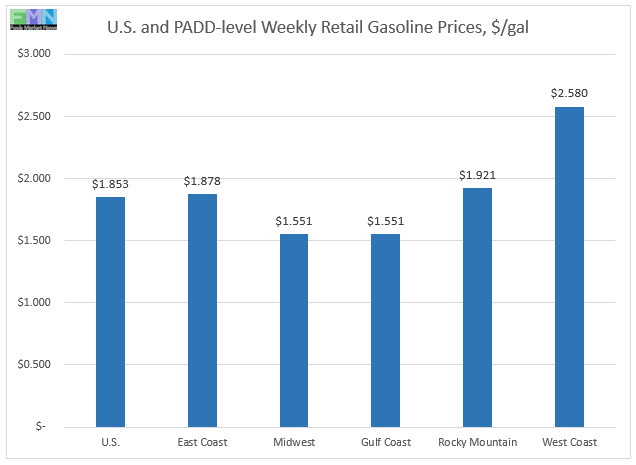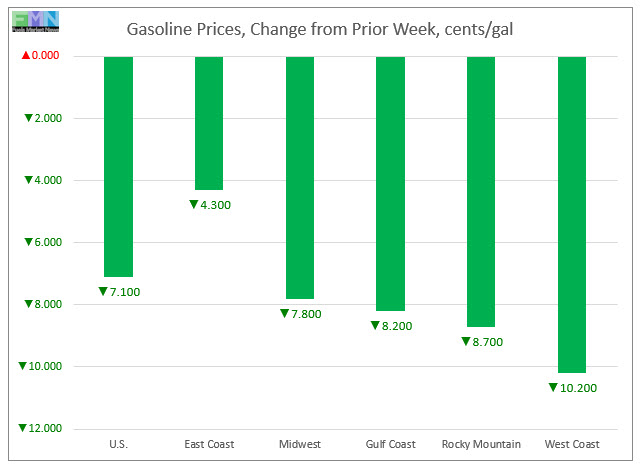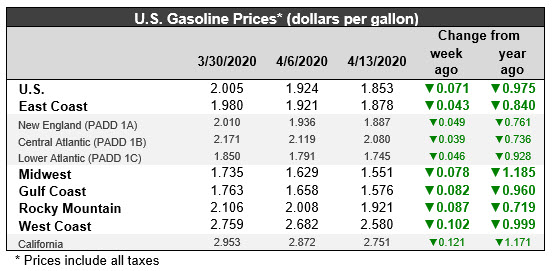

The U.S. Energy Information Administration (EIA) released its weekly data on diesel and gasoline retail prices for the week ended April 13, 2020. Demand destruction caused by the COVID-19 pandemic continues to force prices down. Gasoline and diesel prices both fell, once again by a significant level. Diesel prices fell by 4.1 cents/gallon. Gasoline prices dropped by 7.1 cents/gallon. The national average price for gasoline fell further below the $2/gallon threshold, averaging $1.853/gallon. This price was an incredible 97.5 cents/gallon below the price for the same week one year ago. Prices in four of the five PADDs have fallen below the $2/gallon level. From late-November through early March, gasoline prices had been above their levels from last year. Prices declined until, during the week ended March 2, retail gasoline prices were a mere 0.001 cent/gallon above last year’s level. The dramatic price declines since then have brought gasoline prices significantly below their levels of last year.
Diesel prices also had been above last year’s level, but prices are now well below their levels of last year. On a national average basis, the retail price for diesel averaged $2.507/gallon. This was 61.1 cents/gallon lower than the price in the same week last year. Retail prices for diesel have now fallen for fourteen consecutive weeks, shedding a total of 57.2 cents/gallon.
Futures Prices and Retail Price Outlook
During the week April 3, 2020 to April 9, 2020 (April 10 was the Good Friday holiday,) West Texas Intermediate (WTI) crude oil futures prices rose and fell daily, and crude prices ended the week only $0.19 (0.7%) up. Gasoline futures prices regained 3.8 cents/gallon (5.7%.) Diesel futures prices, in contrast, dropped by 2.05 cents/gallon (2.0%.) In response to the COVID-19 pandemic, the OPEC+ group and a raft of other global oil producers held a series of virtual meetings negotiating a production cut that U.S. President Trump had earlier tweeted would be 10 to 15 million barrels per day (mmbpd). After setbacks, the agreement stands at a cut of approximately 9.7 mmbpd, with uncertainty about the speed of compliance. Buying enthusiasm waned. Today, WTI futures prices are sagging back toward $21/b, after hitting highs of $28/b during the leadup to the OPEC++ meeting. While the relationship between futures prices and retail prices is not immediate or one-for-one, the production cut agreement is viewed as inadequate to balance supply and demand. This is likely to extend the downward trend in gasoline and diesel retail prices in the coming week.
Retail Diesel Prices
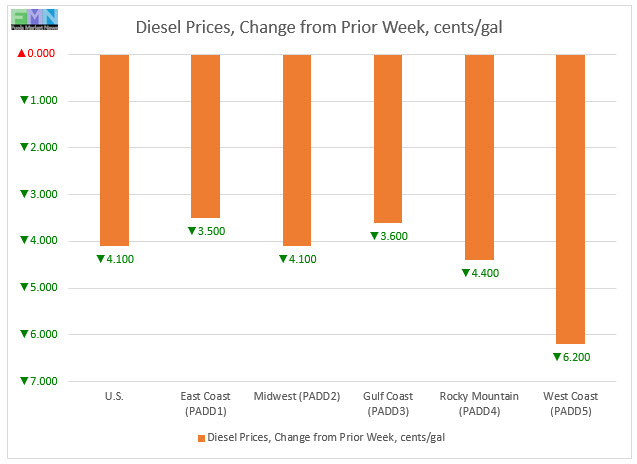
Retail prices for diesel have now fallen for fourteen consecutive weeks—every week this calendar year since the first week of January. Prices have fallen by a cumulative 57.2 cents/gallon. Retail diesel prices had been below the $3/gallon mark until the attacks on Saudi Arabian oil facilities in mid-September 2019. They rose at that time, and they remained above the $3/gallon mark until the week ended February 3, 2020. Prices have continued to slide. For the current week ended April 13, retail diesel prices declined by 4.1 cents to settle at an average price of $2.507/gallon. For the current week ended April 13th, diesel prices fell in all PADDs countrywide. The national average price for the week was 61.1 cents/gallon below where it was during the same week last year.
In the East Coast PADD 1, diesel prices fell by 3.5 cents to settle at an average price of $2.599/gallon. Within PADD 1, New England prices fell by 3.0 cents to average $2.715/gallon. Central Atlantic diesel prices fell by 4.5 cents to average $2.782/gallon. Lower Atlantic prices decreased by 3.0 cents to an average price of $2.450/gallon. PADD 1 prices were 55.4 cents/gallon below their levels for the same week last year.
In the Midwest PADD 2 market, retail diesel prices fell by 4.1 cents to average $2.353/gallon. Prices were 65.7 cents below their level for the same week last year. PADD 2 joined PADD 3 during the week ended June 17, 2019, in having diesel prices fall below $3/gallon, and the retail price of diesel in PADD 2 has not regained the $3/gallon level since then. Prices subsequently fell below $3/gallon in PADD 4 and PADD 1. PADD 5 is the only region where diesel prices remain above $3/gallon, and that by a narrowing margin.
In the Gulf Coast PADD 3, retail diesel prices fell by 3.6 cents to arrive at an average of $2.289/gallon. PADD 3 continues to have the lowest diesel prices among the PADDs, currently 21.8 cents below the U.S. average. Prices were 61.0 cents below their level for the same week in the previous year.
In the Rocky Mountains PADD 4 market, retail diesel prices fell by 4.4 cents to settle at an average of $2.497/gallon. PADD 4 prices were 58.5 cents lower than for the same week in the prior year.
In the West Coast PADD 5 market, retail diesel prices dropped by 6.2 cents to average $3.028/gallon. This was the largest price drop among the PADDs. PADD 5 prices were 62.3 cents below their level from last year. Until December 2019, PADD 5 had been the only district where diesel prices were higher than they were in the same week last year. Subsequently, prices rose until this was true in all other PADDs. However, prices have been falling dramatically, and the national average price is now well below its level of last year. PADD 5 prices excluding California fell by 5.9 cents to settle at an average of $2.695/gallon. This price was 55.7 cents below the retail price for the same week last year. California diesel prices dropped sharply by 6.6 cents to settle at an average price of $3.302/gallon. Until the week ended June 24, California had been the only major market where diesel prices were above $4/gallon, where they had been for nine weeks. California prices retreated below $4/gallon from July through October, rose above $4/gallon again during the first three weeks of November, and eased since then. California diesel prices were 66.5 cents lower than they were at the same week last year.


Retail Gasoline Prices
The COVID-19 pandemic drove U.S. retail gasoline prices below the $2/gallon threshold last week, and prices continued to slide this week. Average retail prices dropped by 7.1 cents/gallon to average $1.853/gallon during the week ended April 13. Prices fell in all PADDs. Retail gasoline prices for the current week were an eye-popping 97.5 cents per gallon lower than they were one year ago. Until November, gasoline prices had been below their levels of last year. Prices then rose to surpass last year’s levels in all PADDs. The current downhill price slide has changed this, making gasoline a bargain again. It has been over four years since the average retail price for gasoline was below the $2/gallon mark.
Gasoline prices hit a peak of $2.903/gallon during the week ended October 8, 2018. Prices then slid downward for fourteen weeks in a row, shedding a total of 66.6 cents per gallon. In the next seventeen weeks, prices marched back up by 66.0 cents/gallon. Prices came very close to the peak they hit in early October. However, the months of May and the June brought an easing of prices amounting to 23.3 cents per gallon. The week ended July 1st reversed that downward trend and sent prices up once again. The recent drop in crude prices is pulling gasoline prices down, and the COVID-19 pandemic is causing a severe contraction in demand as people shelter-in-place.
For the current week ended April 13th, East Coast PADD 1 gasoline retail prices fell by 4.3 cents to arrive at an average of $1.878/gallon. Two weeks ago, PADD 1 joined PADDs 2 and 3 in having retail prices drop below the $2/gallon line. The average price was 84.0 cents/gallon below where it was during the same week last year. Within PADD 1, New England prices dropped by 4.9 cents to average $1.887/gallon. Central Atlantic market prices fell by 3.9 cents, arriving at an average of $2.080/gallon. Prices in the Lower Atlantic market fell by 4.6 cents to average $1.745/gallon.
In the Midwest PADD 2 market, retail gasoline prices fell by 7.8 cents to average $1.551/gallon. For the third consecutive week, PADD 2 prices were below prices in the U.S. Gulf Coast PADD 3 market, a rare occurrence. PADD 2 prices were 30.2 cents/gallon below the average U.S. price during the week ended April 13th. PADD 2 prices for the week were an incredible $1.185/gallon lower than they were for the same week last year.
In the Gulf Coast PADD 3 market, gasoline prices dropped by 8.2 cents to average $1.576/gallon. Four weeks ago, PADD 3 was the first to break the $2/gallon barrier, joined by PADD 2, then by PADD 1, and now by PADD 4. PADD 3 usually has the lowest average prices among the PADDs, but prices in PADD 2 have fallen sharply over the past four weeks, and PADD 2 prices are now the lowest in the land. PADD 3 prices for the week were a hefty 96.0 cents lower than for the same week last year.
In the Rocky Mountains PADD 4 market, gasoline pump prices dropped by 8.7 cents, falling below the $2/gallon level to settle at an average price of $1.921/gallon. This week’s PADD 4 prices were 71.9 cents lower than at the same time last year.
In the West Coast PADD 5 market, retail gasoline prices plunged by 10.2 cents to average $2.580/gallon. As was the case with retail diesel prices, this was the largest price drop among the PADDs. PADD 5 typically has the highest retail prices for gasoline, and until mid-March it had been the only PADD where retail gasoline prices stayed above $3/gallon. Prices this week were 99.9 cents lower than last year’s price. Prices excluding California fell by 7.5 cents to average $2.377/gallon, which was 78.6 cents/gallon below last year’s price. California prices plummeted by 12.1 cents to average $2.751/gallon. California had been the last state where gasoline prices had remained above the $3/gallon line, but the week ended March 30 ended this. On Thursday March 19, California led the U.S. by taking the dramatic step of ordering a statewide shelter-in-place to combat the spread of COVID-19. This order is affecting approximately 40 million people, and it is causing a dramatic drop in gasoline demand, as well as demand for other fuels including jet fuel and diesel. California retail gasoline prices were a massive $1.171 per gallon below their levels from the same week last year.
California prices rose dramatically in late September and early October, attributed to refinery issues, hitting levels above $4/gallon. Prices then began a sustained retreat. four weeks ago, a refinery fire slowed the price decline, but global crude prices have been steadily falling this month, and retail prices are following. Until November, PADD 5 had been the only PADD where prices were higher than they were one year ago. The other PADDs caught up, and prices were higher in all PADDs countrywide. Prices in all PADDs are now significantly lower than they were one year ago.