
“Fueled for Thought,” By Joe O’Brien, Source North America
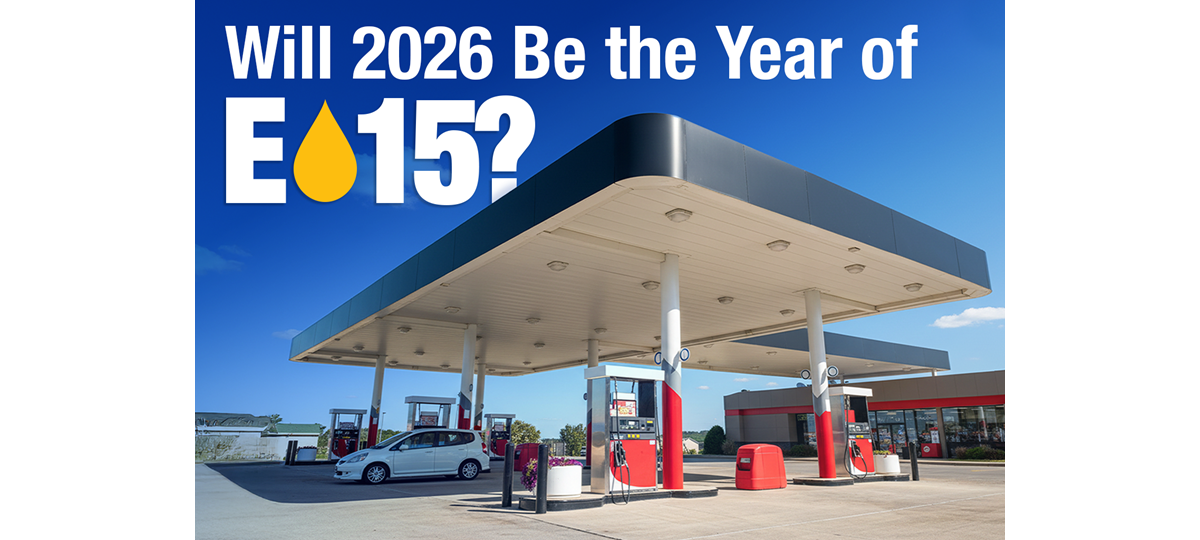
Momentum is building for E15 to become a dominant year-round fuel across the country. Despite the momentum, getting a sense of the rate of expansion may be challenging for fuel marketers amid the substantial quantity of information surrounding E15.
With that in mind, here are two signs that the distribution of E15 will grow, but perhaps on a protracted timeline.
Year-Round E15 Update
All 50 states are permitted to sell E15, but it is only permanently allowed to be sold year-round in a few. As of Oct. 25, 2025, the year-round sale of E15 is approved in California, and eight Midwestern states — Illinois, Iowa, Minnesota, Missouri, Nebraska, Wisconsin, Ohio and South Dakota. Emergency waivers issued by the U.S. EPA since 2022 have authorized the nationwide summertime sale of E15. If supply conditions warrant it, the EPA may issue a nationwide emergency waiver for the 2026 summer months.
Although the year-round sale of E15 is “approved” for nine states, that doesn’t necessarily mean widespread implementation of it will be instantaneous. South Dakota, Ohio and California, for example, are all encountering delays.
Citing concerns about supply chain disruptions impacting refining capabilities in South Dakota, the state requested the EPA to allow South Dakota to delay implementation in 9 counties until 2026. Ohio also requested to postpone implementation because of concerns from the state’s petroleum industry about the ability to install the appropriate infrastructure by the original effective date.
Meanwhile, California faces additional regulatory hurdles.
According to a California Air Resources Board (CARB) FAQ, Assembly Bill (AB) 30 authorizes the sale of E15 as transportation fuel in California if it meets “all applicable federal, state and local requirements.”
Compatibility with Stage II and Enhanced Stage I vapor recovery equipment is a requirement that needs to be addressed. The FAQ reports that “most vapor recovery systems will need to be certified for use with E15 since the equipment was certified for use with E10.”
Furthermore, state law requires approval from five agencies before CARB can provide the necessary certifications. “CARB is working with these state agencies to certify E15 equipment in a manner consistent with current regulations,” the FAQ states.
In addition to the vapor recovery certifications, CARB must complete an exhaustive scientific review before it can adopt the final regulatory specification for the fuel blend. So, while progress is being made to provide California motorists access to E15, market introduction of the fuel is far from imminent.
Compatibility and Labeling Requirements
Currently, the EPA stipulates in 40 CFR 280.32 that UST operators who wish to store fuel containing more than 10 percent ethanol must demonstrate UST system compatibility, including the tank, piping, containment sumps, pumping equipment, release detection equipment, spill equipment and overfill equipment. This can be achieved through “certification” or listing of UST system equipment and components by a nationally recognized, independent testing laboratory or by obtaining written approval from the equipment manufacturer.
In July, the Ethanol for America Act of 2025 was introduced to simplify compatibility and E15 labeling requirements. Among other requirement changes, the proposed bill would deem:
- Steel and fiberglass USTs manufactured after 2005 compatible with E15
- Existing UST systems compliant for storing E15 regardless of whether owners and operators can locate installation or compatibility documentation for those systems
While there is reason for optimism that regulatory requirements may become less restrictive, legislative progress is often in short supply. A speedy passage of the bill is unlikely.
Better Safe Than Sorry
Although a future-focused mindset is necessary for growth, an understanding of the limitations of existing UST equipment is also vital to success. A good first step for fuel marketers who are considering adding E15 to their forecourt is to reach out to a fueling equipment distributor with expertise in biofuels equipment compatibility and federal and state regulations.
While the importance of biofuels compatibility with UST equipment itself is often apparent to fuel retailers, important technical details — such as using compatible thread sealant and the potential consequences of incompatibility — are often not top of mind. A fueling equipment distributor with deep knowledge of UST systems and installation best practices, such as Source North America, can help educate fuel marketers about avoidable pitfalls.
 Joe O’Brien is Vice President of Marketing at Source North America Corporation. He has more than 25 years of experience in the petroleum equipment fuel industry. Contact him at [email protected] or visit sourcena.com to learn more.