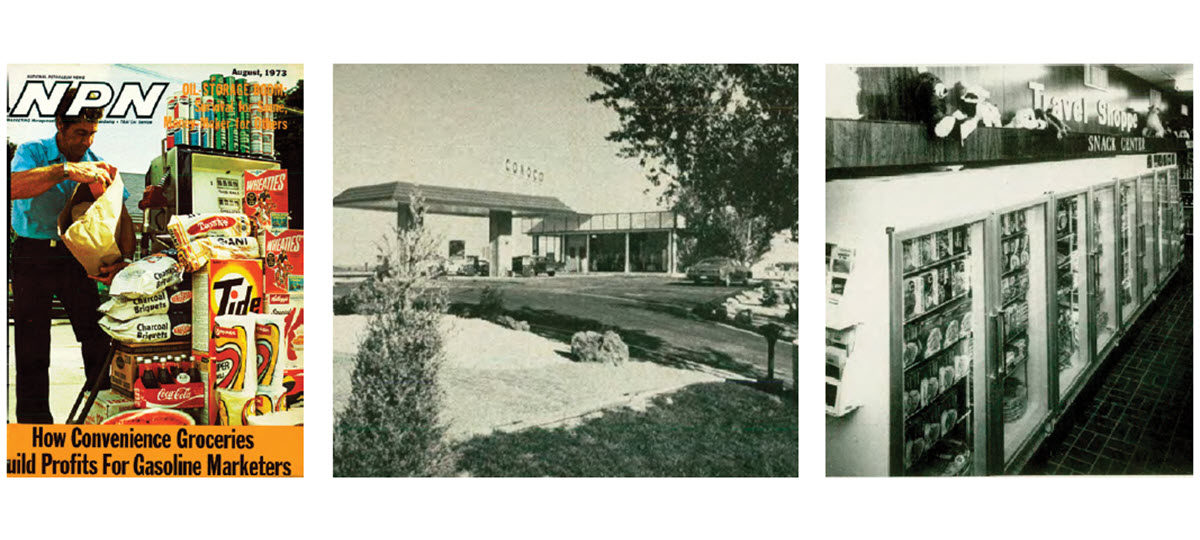

The shift from tires, batteries and accessories to convenience as the primary “ancillary” profit center to gasoline sales built through the late 1960s and really started to take off in the early 1970s. An 11-page article by Joe Link in the August 1973 issue of National Petroleum News, “Convenience Groceries Build Profits for Gasoline Marketers,” took a deep dive into some of the costs and opportunities available to gas station operators looking to make the move.
It’s a fascinating read with a considerable amount of detail. Due to space constraints, I’ve broken it down into a list of bulleted highlights. Note: when grocery is used it represents a broader product mix than might be assumed today.
- The average profit margin on food sales at all convenience stores was about 26% over on average monthly grocery sales of between $15,000 dollars and $30,000 ($106,000–212,00, adjusted for inflation).
- Gasoline sales at convenience stores averaged 30,000 to 40,000 gallons per month. Many of the early conversions were to increase fuel sales at more marginal locations on the back of the convenience offer. One oil company executive noted that “groceries and gasoline make a perfect marriage.”
- Nationally, convenience stores showed an average profit of approximately $6,500 ($45,000 adjusted for inflation) in 1972.
- Out of approximately 21,500 convenience stores at the time, some 3,000 had gasoline. However, there had only been a growth of about 500 stores in the previous two years.
- The article explained that the slowdown was due to the major oil companies who were involved in convenience retail clamping down a new activity while they acquired expertise on how to operate stores. It was noted that the oil companies were attempting to use convenience to sell more gasoline (which did seem to produce results). Conversely, independent jobbers seemed to want to make a good income from store products in addition to gasoline.
- Setting up a convenience operation was seen as being difficult. It was noted that convenience store tie ins with gasoline could be very profitable, but setting up a profitable operation itself was difficult because it magnified personnel problems, pilferage problems and pricing headaches.
- Most oil marketers seemed to find grocery merchandising to be alien territory. Choosing the right mix of merchandise, the right inventory size and the right supplier can have a “life or death effect” on success. And competition can deal a devastating blow: “If a 7-Eleven type store moves in close to you, it will suck you dry,” said Bill Gordon, president of Childress Oil, a Fort Worth Phillips jobbership.
- In a trend that is still active today, convenience stores kept getting larger and larger. Some of the smaller service bay conversion locations concentrated on carrying 25 fast moving products, compared to the 3,000 carried by a typical 7-Eleven at the time. Larger format stores offering between 2,100 and 2,400 square feet could offer between 1,000 and 3,000 items.
- Roughly 50% of all sales fell into 10 categories: bread, beer, delicatessen items, candy, milk, tobacco, soft drinks, snack foods and health and beauty aids. Candy had the highest margin at 28.4%.
It’s interesting that in today’s world the challenges, opportunities and even general profitability of various categories have been fairly consistent. An exception is foodservice, which wasn’t a common offer at the time. And as for the larger stores … that trend has certainly continued.
For more than 100 years, from its founding in 1909 to when it went out of business in 2013, National Petroleum News (NPN) documented the rise of petroleum marketing and retailing in the United States. NACS, PEI and The Fuels Institute have catalogued the rich history of NPN in its entirety. Fuels Market News looks back on occasion at the history of our vibrant industry, through the eyes of NPN, to see how it reflect the issues, challenges and opportunities we face today.